

The Weirdest Exercises Physical Therapists Actually Prescribe (And Why They Work)
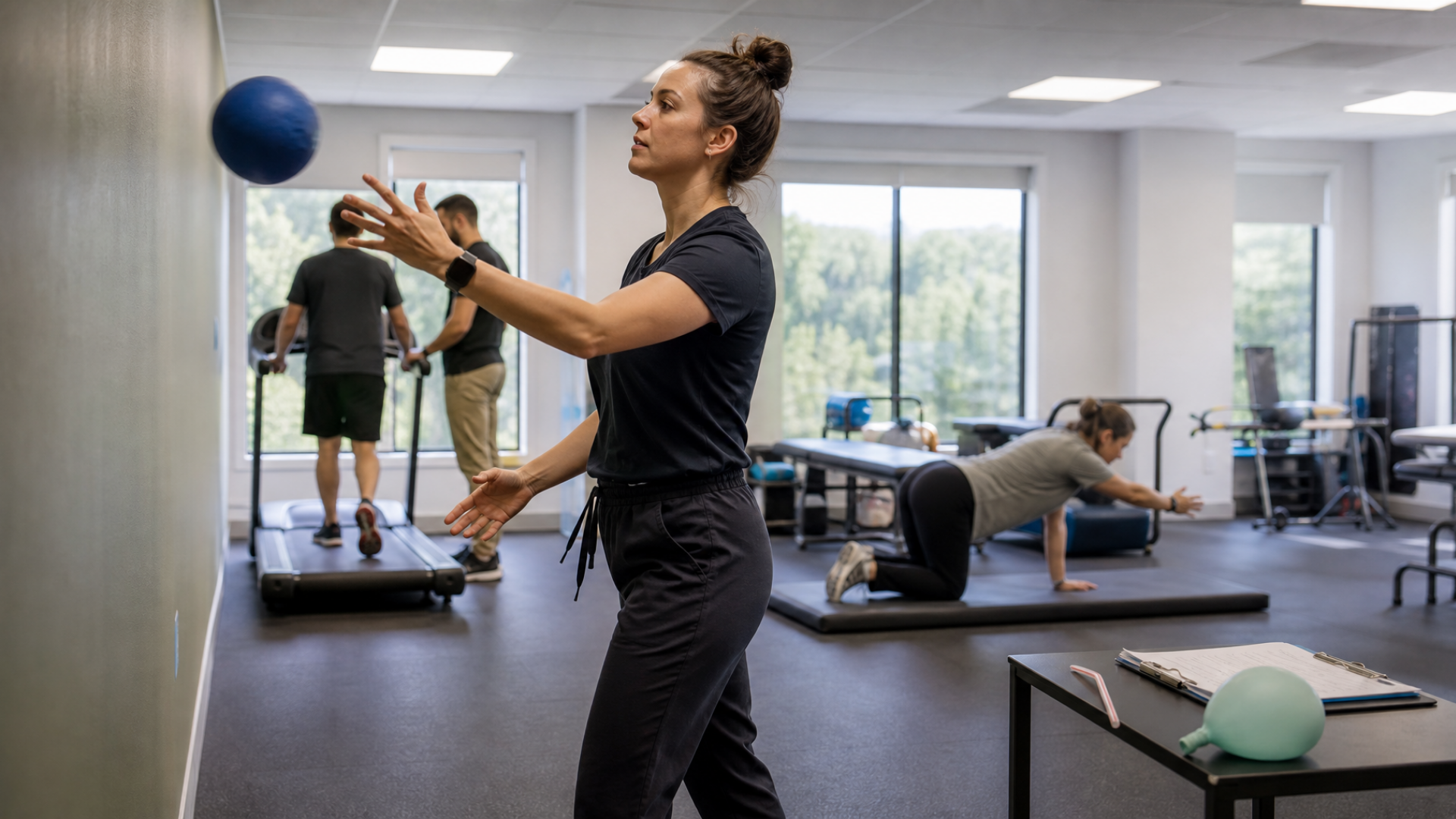
Intro: Why the strangest home exercise program often works best
A patient may question a home exercise program that involves balloons, mirrors, backward walking, or crawling across the clinic floor. The exercise may look odd because its visible movement differs from its clinical target.
A ball toss can train shoulder proprioception and reflexive stability. Resisted breathing can recruit lung volume and control pressure. Mirror work can give the brain visual input that supports cortical remapping, while humming can encourage controlled exhalation and respiratory muscle activity.
Physical therapists prescribe these exercises because each creates a specific sensory, motor, or respiratory demand. The following examples explain what each unusual task trains and why it may earn a place in a carefully progressed program.
Blowing into a straw or balloon after chest or abdominal surgery
A straw or balloon can look like a misplaced party favor beside a postoperative bed. Clinicians use it to create resistance during exhalation, which encourages a slower, more controlled breathing pattern. The exercise may also make respiratory effort easier to observe and cue.
When paired with a deliberate inhalation, resisted exhalation can support lung volume recruitment after chest or abdominal surgery. The exact tool and resistance should match the patient’s surgical precautions, respiratory status, and ability to perform the task without excessive strain.
Throwing and catching a ball off a wall for shoulder rehab
A patient playing catch alone against a wall may look more like recess than rehabilitation. Each rebound changes the force and timing at the shoulder, prompting the rotator cuff and scapular muscles to make rapid, reflexive adjustments. Those repeated adjustments train rhythmic stabilization, proprioception, and co-contraction around the joint.
Physical therapists typically introduce wall tosses later in a post-instability or rotator cuff repair progression, once tissue healing, range of motion, and baseline strength permit faster loading. Ball size, throwing distance, speed, and arm position let the clinician adjust the challenge without changing the basic drill.
Walking backward on a treadmill
Walking backward on a treadmill looks like someone missed the directional memo while everyone nearby moves forward. Reverse gait changes joint angles and muscle demands, and it can shift relative loading toward the knee extensors compared with ordinary forward walking.
Physical therapists may use backward treadmill walking in knee osteoarthritis care or gait retraining when that altered loading pattern fits the assessment. The unfamiliar direction also requires deliberate foot placement and motor sequencing, which gives clinicians a controlled way to practice a different gait strategy.
Chewing gum or jaw exercises for TMJ
Jaw rehabilitation can look contradictory when a physical therapist limits chewing but prescribes repeated jaw movement. The distinction lies in dosage and control. Clinician-prescribed exercises use a defined range, direction, resistance, and repetition count to relax the jaw and improve movement. Physical therapy jaw exercises are recognized as a noninvasive treatment option for temporomandibular disorders.
Chewing gum does not provide the same controlled stimulus. Continuous chewing can increase muscle fatigue, joint stress, pain, and stiffness in an irritable TMJ, so the literature generally treats gum as a possible aggravator rather than an exercise. A physical therapist may prescribe controlled opening, stretching, or resisted movement while asking the patient to avoid unrestricted repetitive chewing.
Mirror therapy for phantom limb pain
A 2021 meta-analysis found that mirror therapy reduced phantom limb pain versus control conditions, with a pooled standardized mean difference of -0.81. The benefit remained significant at roughly three months and six months, although small samples, wide confidence intervals, and substantial variation among studies limited certainty (Neurology Advisor).
During treatment, a patient watches the reflected intact limb move while the mirror conceals the residual limb. The reflection creates visual feedback that represents the missing limb moving normally, which may change how the brain interprets movement and pain signals. Mirror therapy outperformed mental visualization by a wide margin in the review, and it also edged out covered-mirror sham controls, though that comparison drew on fewer studies. Physical therapists should therefore treat it as a supported option with a still-developing evidence base, rather than a settled solution.
Smell training for concussion or COVID-related anosmia
Prescribing rose, lemon, cloves, and eucalyptus as sniffing homework can sound more like aromatherapy than rehabilitation. Yet smell retraining therapy uses these four odor categories to stimulate olfactory pathways after minor head trauma or persistent postviral smell loss, including loss associated with COVID-19.
The standard routine asks the patient to smell each scent for 10 to 20 seconds once or twice daily for at least 12 weeks. During each exposure, the patient focuses on the odor and actively recalls how it should smell rather than sniffing passively.
Repeated exposure may support recovery through the olfactory neurons’ capacity to regenerate. Focused recall also trains the brain to reconnect incoming sensory information with stored odor memories, which helps explain why repetition and attention both belong in the prescription.
Singing or humming for breathing and vagal tone
A pulmonary rehab session can sound like a karaoke warm-up when patients hum, perform lip trills, and sustain notes. Singing pairs a short inspiration with a controlled, prolonged expiration, which engages the diaphragm and other respiratory muscles more continuously than ordinary speech. Singing-based pulmonary rehab programs commonly combine vocal work with posture, diaphragmatic breathing, and slow exhalation.
A 12-week pilot randomized controlled trial in 40 people with stable COPD found greater gains with singing training than with health education alone. Dynamic diaphragmatic mobility increased by 0.7 cm versus 0.1 cm. Six-minute walk distance improved by 52 meters versus 5 meters, and respiratory quality-of-life scores also improved.
Clinicians may discuss humming in relation to autonomic regulation, but this trial did not measure vagal tone. The supported rationale centers on respiratory muscle activation, expiratory control, and diaphragmatic mechanics.
Crawling patterns for adult core and shoulder stability
Bear crawls can make a clinic session look like a group of adults imitating toddlers. The quadruped position places weight through the hands and asks the trunk and shoulder girdle to control movement while the limbs change support.
Contralateral patterns pair one arm with the opposite leg, which challenges the trunk to resist rotation and the scapular muscles to maintain shoulder control. Adding forward, backward, or lateral travel increases the demand without isolating either region. Crawling therefore gives physical therapists a loaded, closed-chain alternative to separate core and shoulder exercises, with speed and range adjusted to match the patient’s capacity.
Where clinicians build and assign programs like these
An unusual exercise still needs clear instructions and a practical way to monitor response. Clinicians can use Physitrack’s 18,000+ exercise library and smart search program builder to assemble a home exercise program, assign it, and adjust the prescription as rehabilitation progresses.