Benefits of AI in Physical Therapy: Practical Uses for Clinicians and Practices
TL;DR
- AI can draft routine messages, summarize information, and reduce repetitive administrative work.
- AI-assisted search can narrow large exercise libraries, while clinicians choose and approve each exercise.
- Documentation tools can structure or summarize notes, but clinicians must verify accuracy before finalizing them.
- AI can tailor patient instructions and reminders, while adherence data can help clinicians identify declining participation early.
- Movement analysis tools can measure motion through camera-based tracking, but image quality and patient setup affect their accuracy.
- Clinicians remain responsible for diagnosis, treatment planning, red-flag screening, and billing decisions. Privacy, bias, and local regulations also require review before adoption.
What "AI in physical therapy" actually means
AI in physical therapy usually refers to software that assists with a narrow task in physical therapy, which many countries call physiotherapy. The software may recognize patterns in movement data, match a written query with relevant exercises, draft routine text, or track changes in patient activity. These tools create practical value when they reduce repetitive work or provide information for a clinician to review without making autonomous care decisions.
AI assistance provides suggestions rather than clinical conclusions. For example, an exercise search tool can narrow a large library based on a clinician’s request, but the clinician decides whether an exercise suits the patient. Documentation software can draft a note, but the clinician must verify its accuracy. Autonomous diagnostic AI belongs to a different category because it attempts to make clinical decisions without direct confirmation. Most AI tools used in routine physical therapy do not operate that way.
Clinicians remain responsible for assessment, diagnosis, treatment planning, and safety decisions. AI cannot reliably account for every factor uncovered through conversation, physical examination, or ongoing therapeutic contact. AI outputs can also contain errors or reflect bias in their training data.
Rules for artificial intelligence in physical therapy vary by country. Local laws and professional guidance may govern health data, software classification, consent, clinical accountability, and reimbursement. A tool permitted for one purpose in one jurisdiction may face different requirements elsewhere. Clinicians and practice owners should therefore evaluate both the tool’s function and the rules that apply where they deliver care.
Where AI creates practical value: benefits table
AI tools can support specific tasks, but clinicians remain responsible for reviewing outputs and making care decisions.
Cutting administrative and scheduling busywork
Administrative AI can reduce non-clinical work by creating drafts from information you already collect. A tool might summarize an intake form, prepare an appointment reminder, populate a routine follow-up message, or turn a cancellation request into a task for reception staff. The clinician or staff member reviews the output instead of starting with a blank page.
AI can also support scheduling without controlling the appointment record. For example, an assistant might categorize patient requests, identify suitable openings, or draft waitlist messages. Your scheduling system should still record appointment availability, confirmations, cancellations, and attendance. Practice management and billing systems should likewise remain the source of truth for patient records, invoices, payment status, and other operational data.
Practices can adopt administrative AI as a task-specific layer around those core systems. You can replace or update a drafting tool without rebuilding the scheduling or billing workflow. Clinicians and staff should confirm names, dates, instructions, and recipients before sending any AI-generated communication.
Time saved on repeated tasks can accumulate across a working week. When clinicians spend less time preparing routine messages or condensing repetitive information, they can use more of their available capacity for patient care and necessary clinical work. Any time savings depend on accurate output and appropriate data handling, with a clinician or staff member reviewing the work.
Faster exercise discovery and program building
AI-assisted search reduces the time clinicians spend navigating exercise libraries. Manual browsing often requires clinicians to open categories, try several keywords, and review exercises one by one. AI can interpret a description of the intended movement, body area, or rehabilitation goal and return a smaller set of relevant options.
Physitrack’s AI Exercise Search provides one example. A clinician can describe the exercise they need in everyday language instead of relying on an exact library label. The tool searches the existing exercise library and surfaces possible matches for review.
A narrower candidate set gives the clinician fewer options to review before comparing appropriate variations. For example, a search may surface several ways to train the same movement with different equipment or starting positions. The clinician can then choose an option that fits the patient’s ability, available equipment, and home environment.
The clinician still controls every clinical decision. AI Exercise Search does not assess the patient, select the final exercise, or prescribe dosage. Before adding an exercise, the clinician must check it against the patient’s assessment findings and goals. The clinician must also confirm the instructions and progression. AI narrows the search space, while the clinician builds and approves the home exercise program.
AI-assisted documentation and note support
AI documentation tools can reduce typing by turning clinician-provided information into a draft note. For example, a tool might summarize a visit transcript and place reported symptoms or measured findings into the appropriate fields. Another tool might expand shorthand into complete sentences or apply a consistent note structure. The clinician still controls what information enters the record.
Generated documentation must not replace clinical reasoning. An AI tool may organize observations, but it cannot independently determine whether a patient has progressed, whether a finding changes the treatment plan, or whether symptoms require referral. The clinician must make those judgments and document the reasoning behind them.
Clinician review and editing are non-negotiable before finalizing any AI-assisted note. Generated text can contain incorrect measurements, confuse body sides, omit context, or add unsupported statements. The clinician should compare the draft with the actual encounter, correct errors, remove assumptions, and confirm that the final record meets local documentation requirements. Responsibility for the signed note remains with the clinician.
AI note support remains an emerging capability, so practices should evaluate each tool carefully. A useful system should show the source material and allow clinicians to correct its output. It should also preserve an audit trail where required. Practices must also assess patient consent, data storage, and access controls under the health data rules that apply in their country.
Personalizing patient communication and engagement
AI can tailor patient communication to a person’s language, reading level, and treatment context. For example, a tool might rewrite exercise instructions in plain language, translate a reminder, or explain why a home exercise relates to the patient’s goal. Clearer communication can reduce confusion and make the program easier to follow.
Personalization also applies to timing and format. A patient who misses evening sessions may benefit from an earlier reminder, while another may need shorter instructions supported by video. AI can suggest these adjustments based on available preferences and activity patterns, but the clinician should decide whether each adjustment suits the patient.
Home exercise delivery gives personalized communication a practical route to the patient. Physitrack lets clinicians deliver home exercise programs through PhysiApp, where patients can view exercise instructions and record their progress. Clinicians may use AI-assisted content when preparing those communications, but Physitrack or any connected AI tool should not change a prescribed program without clinician approval.
Clinician review remains necessary because automated translation and simplified wording can alter clinical meaning. Language preferences also vary within countries, and a direct translation may miss local terminology or cultural context. Before sending AI-generated material, clinicians should check its accuracy, tone, accessibility, and suitability for the individual patient. Personalization should support conversations between clinicians and patients rather than replace them.
Spotting adherence signals early
Patient activity data can indicate declining participation between visits. AI and rule-based analytics can monitor changes such as fewer completed sessions, longer gaps between sessions, or repeated difficulty with a specific exercise. A dashboard can then bring unusual patterns to the clinician’s attention instead of requiring manual review of every patient record.
Clinicians use these signals to decide who may need support. For example, a sudden drop in recorded activity could prompt a message asking whether pain has increased or the instructions remain clear. The clinician interprets the response and decides whether to explain an exercise, modify the program, or arrange a reassessment.
Physitrack provides adherence tracking and analytics for home exercise delivery. These capabilities help clinicians monitor patient follow-through between visits. They complement scheduling and billing systems, which remain the source of truth for appointments, payments, and other operational records.
Adherence data cannot explain why a patient disengages. A low completion rate might reflect worsening symptoms or a technical problem, while missing data may simply mean the patient did not record an activity. The software flags a pattern, and the clinician confirms its meaning through direct communication and clinical assessment.
AI-assisted movement analysis
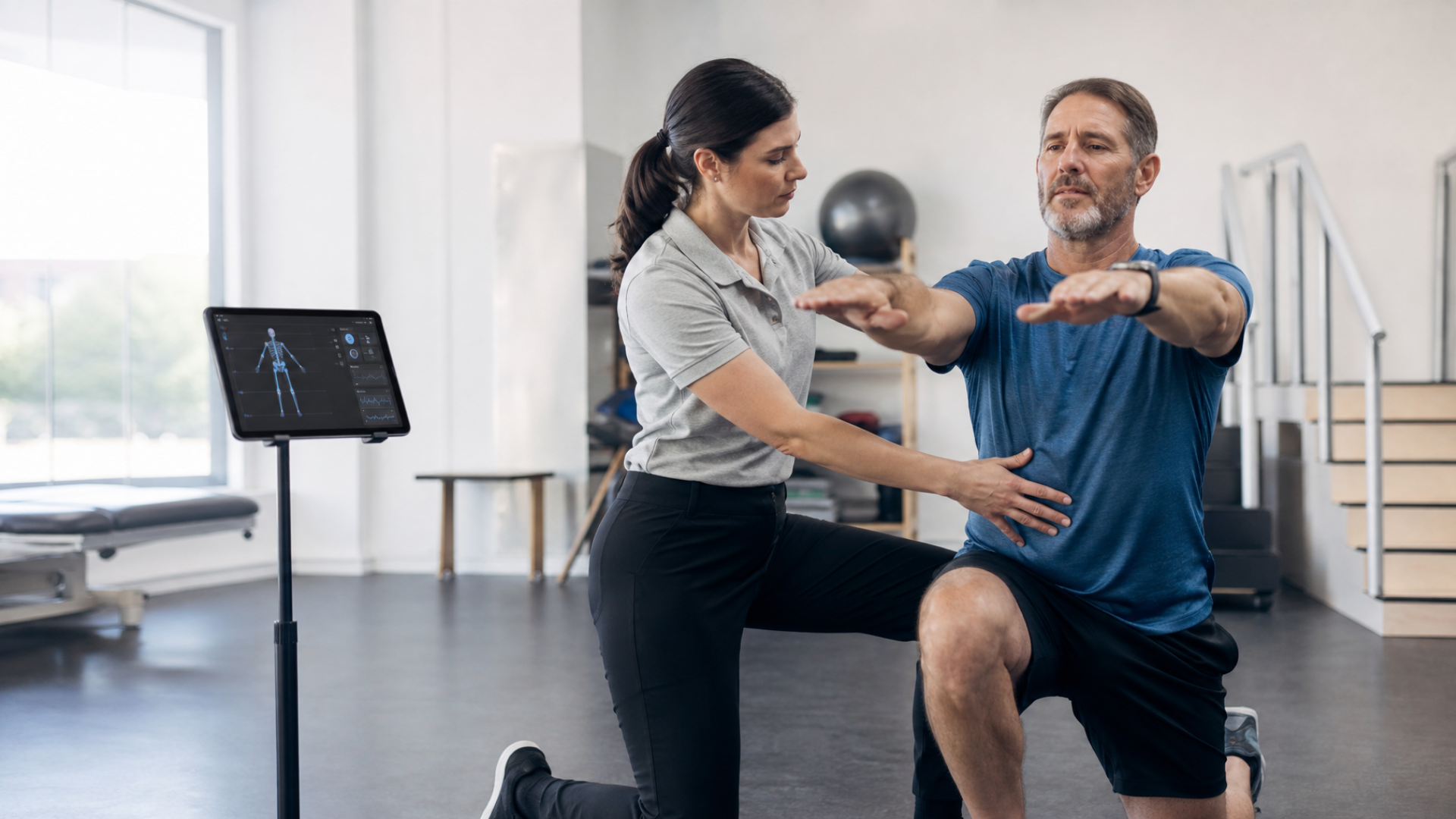
Computer vision can add measurable movement data to a clinician’s visual assessment without requiring wearable sensors or laboratory equipment. A phone, tablet, or computer camera records the patient performing a movement. Software identifies body landmarks in each frame and estimates measures such as joint position, range of motion, and movement timing.
Sensor-free motion capture helps clinicians compare movement across sessions when the camera setup remains consistent. For example, a clinician assessing a squat may review estimated knee and hip motion alongside the video rather than relying on visual recall alone. The measurements can support progress reviews and patient education without requiring the markers and specialized setup used in motion laboratories.
Physitrack’s sensor-free motion capture provides a concrete example of this approach. The technology gives clinicians additional movement information that they can interpret alongside symptoms, medical history, functional testing, and treatment goals. It does not diagnose an injury or choose a treatment plan.
Camera-based estimates depend on recording conditions. Poor lighting, loose clothing, an obstructed body part, or an unsuitable camera angle can reduce measurement quality. Results may also vary across devices or patient characteristics if the underlying computer-vision model has not represented them adequately. Clinicians should check whether the recorded movement and calculated measures make clinical sense before using them.
Movement analysis remains decision support. A camera cannot assess tissue response, pain behavior, balance confidence, or other findings that may require direct observation and hands-on assessment. Clinicians remain responsible for deciding whether the captured data are useful and how they influence care.
Where AI stops and clinical judgment takes over
AI tools can organize information, suggest options, and identify patterns, but clinicians remain responsible for every clinical decision. An exercise search tool can narrow a library, but the clinician selects each exercise and checks its suitability. Documentation software can draft or summarize a note, but the clinician must correct errors and approve the final record.
Clinicians must retain control over diagnosis, treatment planning, and red-flag screening. Adherence data may show that a patient stopped completing exercises, but it cannot determine whether pain, access, motivation, or another issue caused the change. Movement analysis can quantify visible motion, but the clinician must interpret those measurements alongside the patient’s history, symptoms, goals, and physical assessment.
Billing decisions also require human confirmation. AI may suggest a code or identify missing information, but the clinician or authorized billing professional must verify that the code matches the documented service and local requirements. Physical therapy practices should not allow software to finalize clinical or billing decisions without human confirmation. Any tool that presents its output as final should receive close scrutiny before clinical use.
Privacy, accuracy, and bias: what clinicians should ask vendors
A vendor review should test how an AI tool handles patient information, produces outputs, and supports clinician oversight. Legal requirements vary by country, so you should assess each tool against local health data rules and professional guidance.
-
Where does the vendor store and process patient data? Ask where the vendor hosts the data and whether subcontractors can access it. Confirm how the vendor encrypts, retains, exports, and deletes records.
-
Does the vendor use patient data to train its AI? Determine whether training happens by default and whether your practice or patients can decline. The contract should explain whether the vendor removes identifying information before any secondary use.
-
What legal basis supports data processing? The GDPR and similar legal frameworks may require a lawful basis for processing and additional safeguards for health information. HIPAA applies only in relevant US settings. Consent requirements and patient rights differ across jurisdictions, so local legal advice may be necessary.
-
How did the vendor test accuracy? Ask which patient populations, clinical settings, and tasks appeared in validation studies. A tool tested on healthy adults in controlled lighting may perform differently during home movement analysis involving older adults or people with mobility limitations.
-
How does the tool communicate uncertainty? The tool should indicate when an output has low confidence and let clinicians correct errors. Ask whether you can review source information, edit generated content, and report mistakes before an output enters the patient record or care plan.
-
Could training data create biased results? Underrepresentation by age, skin tone, body type, disability, or cultural context can affect movement analysis and exercise suggestions. Vendors should describe their testing across relevant populations and any known performance limits.
-
Who remains accountable for the final decision? The vendor should define which outputs require clinician approval. Audit records should show what the AI produced, what the clinician changed, and who approved the final version.
Practice owners should repeat these checks after major software updates. Model behavior and data practices can change even when the user interface looks familiar.
AI-enabled practice operations
Current AI tools support discrete operational tasks without becoming a practice’s central record. Physitrack’s AI Exercise Search helps clinicians find relevant options within an exercise library, while the clinician reviews and approves the final program. Adherence reporting can surface reduced patient activity, and digital communication tools can help clinicians deliver reminders or clarify home exercise instructions.
Practices can use these capabilities alongside their existing scheduling, billing, and patient-record systems. For example, an adherence report may flag declining activity and prompt a clinician to contact the patient. The clinician can then ask about pain, access barriers, or confusion before adjusting the program.
Scheduling and billing platforms should remain the source of truth for appointments, charges, claims, and payments. AI-generated summaries or suggested actions require review before anyone uses them to update an operational record. Practice owners should also define which system controls each type of data so staff do not act on conflicting information.
A practice can adopt each capability separately after checking its technical compatibility and local data protection requirements. This modular approach lets clinicians reduce repetitive work while keeping clinical and operational decisions under human control.
FAQs
-
Is AI replacing physical therapists? Current AI tools handle narrow tasks such as searching exercise libraries, drafting notes, and analyzing movement recordings. Physical therapists remain responsible for assessment, diagnosis, treatment planning, red-flag screening, and patient care decisions.
-
Is patient data safe with AI tools? Data safety depends on the product and how your practice configures it. Ask vendors where they store data, whether they use patient information to train models, and how they control access. You should also confirm that the tool meets consent and health-data requirements in your country.
-
How accurate is AI movement analysis? Accuracy varies by tool, movement, camera position, and recording environment. Clothing or poor lighting can reduce tracking quality. Ask vendors how they validated their model and whether the validation included patients similar to yours. Use the output as assessment support rather than an automated diagnosis.
-
Do I need special training to use AI tools in practice? Most task-specific tools require product training rather than advanced technical knowledge. Clinicians still need to understand the tool’s limits, review its outputs, and recognize errors. Practice owners should document who may use each tool and how staff should check its work.
-
Does AI help with insurance or billing decisions? AI can summarize payer information supplied to it, draft supporting text, or flag missing fields. A clinician or billing specialist must confirm codes, coverage criteria, and documentation before submission. Insurance rules vary by payer and country, so an AI suggestion should never serve as the final billing decision.
The bottom line for clinicians and practice owners
AI in physical therapy offers the clearest near-term value when it saves time while keeping clinicians responsible for patient care. Useful tools can help clinicians find exercises, prepare drafts, summarize supplied information, or detect patterns in recorded data. Clinicians still interpret the output and make the decision.
You should evaluate each AI tool against a specific clinical or operational task. Ask whether the tool produces information you can review, correct, and reject. Check how the vendor protects patient data and tests accuracy across relevant populations. Confirm separately that your use of the tool meets local legal requirements. Avoid products that conceal their limits or imply that software can replace assessment and professional judgment. A worthwhile tool gives clinicians more time and better information without weakening their control.