Practice Management Software for Multi-Location Physiotherapy Clinics in Australia
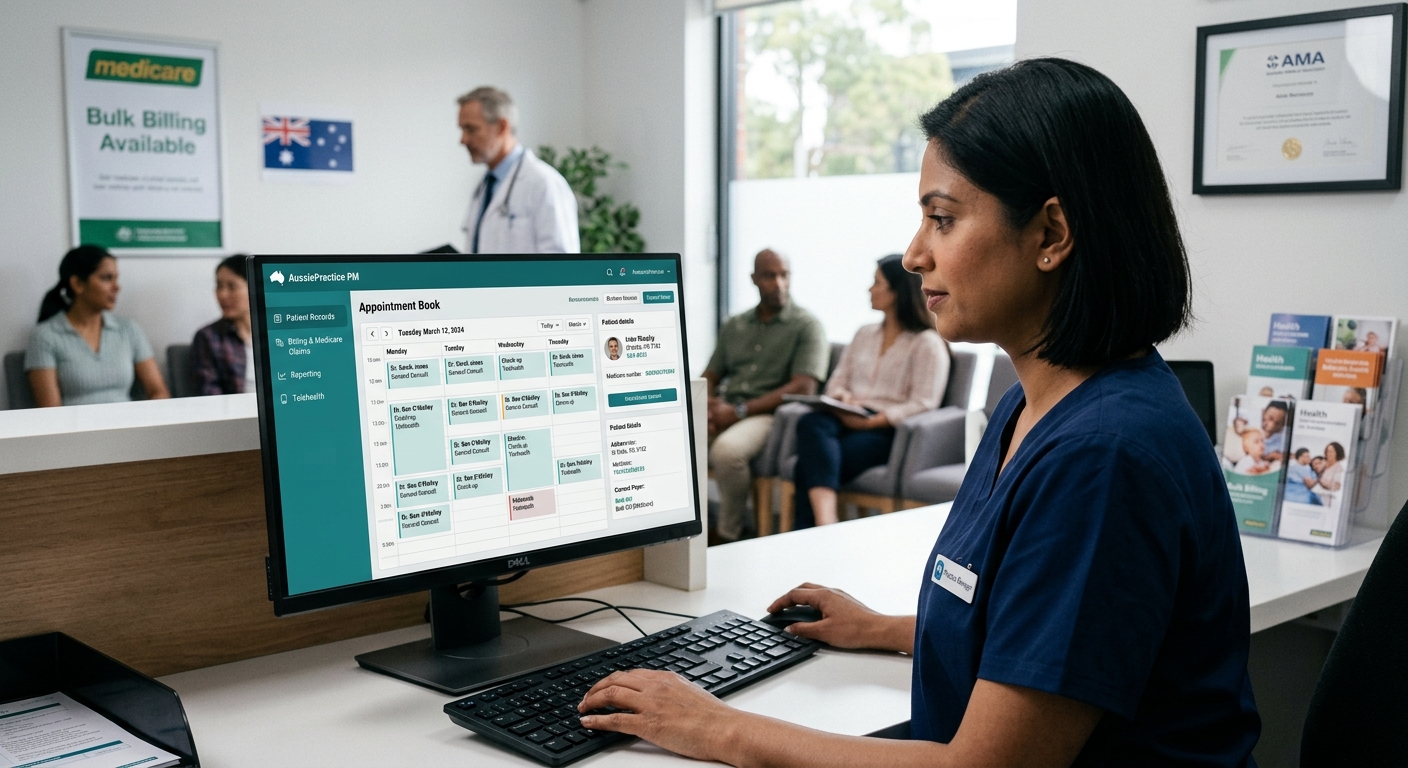
Practice management software for multi-location physiotherapy clinics
Multi-site groups should score core practice management software and specialist clinical tools separately across four criteria.
- A shared layer for home exercise programs and protocols should give every clinic consistent content. Physitrack fits here as an exercise prescription and remote monitoring layer.
- Interoperability should move patient and clinical data between Physitrack and the PMS or EHR without duplicate entry.
- Multi-site reporting should compare financial and clinical performance by clinic and clinician. Australian platforms vary in their cross-site reporting capabilities.
- The core PMS should support private health billing and relevant Medicare and DVA claiming channels, with reconciliation by location and provider number.
Why multi-site groups need central control
Multi-site groups should evaluate two layers separately: a core PMS for administration, reporting, and Australian billing, and a specialist clinical layer for shared exercise protocols and monitoring. Score each layer separately, then assess the combination on standardisation, two-way interoperability, cross-site reporting, and billing by location and provider number. A multi-location group must also control how clinicians and administrators work across sites. A low-cost platform can become expensive to manage when each clinic configures records, exercise programs, billing, and reporting differently.
Cloud-based software can give every location access to the same up-to-date data. BlueRock specifically recommends cloud architecture for organisations with multiple practice locations because it supports data synchronisation across sites. During vendor demonstrations, ask whether updates to patient details, templates, permissions, and fee schedules appear across locations without manual duplication.
Cloud access alone does not create consistent clinical operations. Your software must let head office define shared protocols while allowing clinicians to adjust care for individual patients. Owners also need permissions that separate local responsibilities from group-wide controls, so a clinic manager can run one site without changing settings for every location.
Standardising exercise protocols and home exercise programs across every clinic
Multi-site standardisation requires a centrally managed protocol library that every clinic can access. Head office should control approved templates and updates, while clinicians retain room to adjust programs for individual patients. The platform should record the protocol version each patient received and show adherence and patient-reported responses across locations.
Library size indicates clinical breadth, but governance controls determine whether you can deliver consistent care. Physitrack provides more than 18,000 exercise videos in 14 languages, along with shared protocols and outcome-management tools for multi-site organisations. Its PhysiApp gives patients consistent program delivery and sends adherence data back to clinicians.
Wibbi claims more than 20,000 rehabilitation exercise videos across more than 18 specialties. An IntuitionLabs directory of rehabilitation software also lists more than 300 program templates. The available sources do not document language coverage or the central governance and cross-site auditing controls needed to confirm multi-site standardisation.
Evidence for Rehab Guru is more limited. A Physitrack comparison positions it as a lower-cost exercise-prescription tool for smaller Australian and New Zealand clinics, but an independent source does not confirm its language coverage or multi-site controls. Ask Rehab Guru to demonstrate these capabilities rather than treating the missing evidence as proof that they are absent.
Score each vendor separately for library breadth, patient-language coverage, central template control, version history, and cross-site adherence reporting. A vendor should pass only when an administrator can centrally manage one approved protocol across every clinic and audit its use by location.
Interoperability between the practice management system and clinical tools
A useful integration moves information in both directions between the practice management system or EHR and the exercise-prescription platform. Patient details and assigned programs should flow into the clinical tool, while adherence data, reported symptoms, outcomes, and program changes should return to the system of record automatically. Single sign-on only removes a separate login and does not prove that any clinical data moves.
Multi-site suitability depends on both the core PMS and the data exchanged by its clinical connectors. Cliniko markets itself as allied health practice management software supporting multi-location clinics, so require the vendor to demonstrate which types of patient, program, adherence, and outcome data its Physitrack connector exchanges across locations. BlueRock describes Nookal as a multi-location platform for central practice management and reporting. If Halaxy is on your shortlist, ask the vendor to demonstrate the same data-flow capabilities rather than assuming that cloud access provides clinical interoperability.
Named connectors help you narrow the shortlist, but they do not establish integration depth. For example, Wibbi lists Cliniko, Nookal, and TM3 among its integration partners, although its public partner list does not explain whether each connector provides two-way clinical data synchronisation. When evaluating Physitrack as the specialist HEP and monitoring layer, verify the connector’s data flow and require any shortlisted alternative to meet the same two-way standard.
During each vendor demonstration, create a test patient in the PMS and assign a home exercise program. Record the patient's exercise completion and clinical response in the app, including discomfort and an outcome measure. Then ask the vendor to show where those results appear in the PMS without copying, exporting, or re-entering them. A passing integration updates the correct patient record automatically and shows when synchronisation occurred. The integration should not create duplicate records across locations.
Multi-site reporting and analytics for comparing clinic performance
Multi-site reporting should compare each clinic using consistent measures while preserving a group-wide view. An operations leader needs to filter financial results by location and clinician, then compare revenue and profitability over the same period. Aggregate totals can conceal a clinic with strong revenue but weak margins.
For core PMS reporting, Nookal is one documented example; Physitrack serves a separate role as the specialist clinical layer. BlueRock reports that Nookal offers multi-location financial and clinician-performance reporting, including profitability by location. During vendor demonstrations, ask whether each report can compare locations side by side and show results for individual clinicians.
Clinical reporting requires comparable outcome measures across the group. Your software should show patient outcomes and whether patients complete prescribed programs. Reports should also account for appointment volume or clinician hours, since raw totals can make larger clinics appear more effective.
Treat patient-level clinical monitoring and group financial reporting as separate requirements. Patient-level clinical records help clinicians adjust care, but they do not replace financial and operational reporting in the core practice management system. When evaluating Physitrack for adherence and patient-reported outcomes, confirm whether the chosen integration sends usable data back to the group’s reporting environment.
Test each vendor with a practical request. Ask for a report comparing profitability and clinical outcomes across two locations, with filters for date range and clinician. A suitable platform should produce the comparison without manual spreadsheet consolidation.
Medicare, DVA, and private health fund billing across locations
Test Australian billing support for each claim type and submission channel instead of treating billing as one feature. Services Australia lists four channels for Medicare Benefits Schedule and DVA claims. ECLIPSE handles Simplified Billing and patient claims for in-patient services. Easyclaim submits bulk-billing and patient claims through an EFTPOS device or practice management software, while HPOS Webclaims and Medicare Online support eligible Medicare and DVA claims.
Private health fund claims use a separate workflow. Australian practice management software may connect with HICAPS or Tyro Healthpoint for on-the-spot claiming, but you should verify the supported funds, terminal requirements, gap-payment handling, and settlement records. A general claim of private health integration does not establish that every clinic can use its existing terminals and merchant arrangements.
Multi-site groups also need billing records that preserve the correct location and provider details. Ask each vendor to demonstrate how its software assigns provider numbers, separates revenue by clinic, reconciles payments, and handles rejected or adjusted claims. The demonstration should include a clinician working across two locations and a finance user reconciling both sites without exporting and rebuilding the data manually.
For groups evaluating Nookal as their core PMS, BlueRock’s Australian practice-management software guidance documents integrations with Medicare and the NDIS for billing and payments. The available independent evidence does not confirm equivalent channel-level support across every other named platform. Treat missing documentation as a verification task rather than proof that a feature is absent. Your contract should identify the supported Medicare, DVA, HICAPS, and Tyro workflows, including any third-party fees or hardware dependencies.
Where a specialist HEP and remote monitoring layer like Physitrack fits
Physitrack fits beside a group’s practice management system as its exercise prescription, home exercise program delivery, adherence tracking, and remote monitoring layer. Your core PMS should continue to manage appointments, patient records, provider numbers, invoicing, and Australian claims workflows.
Test the clinical layer as a group workflow rather than as a content library. Have head office publish one approved protocol, ask clinicians at two sites to tailor it, and verify that leaders can review completion and patient-reported responses by location.
Score Physitrack separately from the PMS on reporting and billing. Physitrack’s clinical dashboards support patient monitoring and outcome review, but the PMS must handle cross-location financial comparisons and Medicare, DVA, and private health fund claims. Treat remote monitoring as a clinical capability rather than evidence of Australian reimbursement support.
Vendor scorecard: what good looks like
- [ ] The vendor passes standardisation if head office can centrally manage shared exercise protocols and home exercise programs and review adherence by clinic.
- [ ] The vendor passes interoperability if patient and program data move automatically between the PMS or EHR and the clinical add-on in both directions.
- [ ] The vendor passes reporting if owners can compare financial performance and clinical outcomes by location and clinician rather than receiving group-wide totals alone.
- [ ] The core PMS passes billing if it can process private health claims and submit claims through applicable Medicare and DVA claiming channels, then reconcile payments by location and provider number. Require the vendor to demonstrate each workflow with your billing configuration.
Score the core PMS and specialist HEP or remote monitoring add-on separately, and combine their scores only after testing how data moves between them.
Next steps for evaluating your shortlist
Run the scorecard against two or three practice management systems using sample patient records that reflect your real workflows and reporting needs. Ask each vendor to demonstrate the data flow and confirm any Australian billing requirements in writing.
Then consider a Physitrack trial alongside your existing or preferred PMS. Test program assignment and data movement between platforms, then confirm what head office can monitor across locations. Choose the core PMS for administration and billing and the specialist layer for exercise prescription and remote monitoring of home programs.
Perguntas frequentes
Can one system handle billing and home exercise program delivery?
An integrated billing and home exercise setup connects the two functions in one workflow, whether they sit in one suite or in linked systems. Physitrack provides exercise prescription, patient delivery, adherence tracking, and remote monitoring alongside a compatible practice management system. Using linked layers lets a group meet Australian claiming requirements without sacrificing clinical capability.
How many locations require multi-site features?
Multi-site features become relevant as soon as two clinics share patients, clinicians, protocols, or financial oversight. Physitrack can provide shared exercise content and consistent home exercise program delivery across those locations. Central controls reduce duplicate setup and help owners compare how clinics apply agreed protocols.
Does Physitrack replace physiotherapy practice management software?
Practice management software handles functions such as scheduling, patient records, invoicing, claiming, and business reporting. Physitrack complements that core system with exercise prescription, program delivery through PhysiApp, adherence data, and remote monitoring. An integration can keep clinical workflows connected while the practice management system remains the main administrative record.
.png)

