How to Grow an Instagram Account as a Physical Therapist
En bref
- Choose a niche based on the patients you want to attract, such as sports rehab, pelvic health, orthopedics, or geriatrics.
- Build a consistent schedule around Reels that demonstrate exercises, debunk injury myths, share patient-authorized stories, and show clinic life.
- Write captions and alt text with patient search terms, local phrases, and specific conditions. Obtain valid written authorization before sharing any identifiable patient information.
- Track saves, shares, and profile visits instead of focusing on likes. Convert interest through a clear booking link, prompt replies to DMs, local hashtags, geotags, and direct calls to action.
- Healthcare accounts grow when useful education demonstrates clinical expertise. Visual polish supports clarity, but aesthetics alone rarely give patients a reason to book.
Why undifferentiated PT accounts stall on Instagram
Generic physical therapy accounts often stall because neither viewers nor Instagram can identify whom the content serves. A feed that jumps between running injuries, pelvic health, post-surgical rehabilitation, and general wellness gives potential followers little reason to expect a useful next post. Specific accounts create a clearer expectation and attract people with related needs.
Choose a niche by comparing your current caseload with the patients you want to see more often. Review your last 30 patients and note the conditions you treat frequently. Then identify which type of patient you most want walking through the door. The overlap might point toward sports rehab or pelvic health. Orthopedics and geriatrics offer other clear directions.
Turn your choice into a one-sentence content promise. For example, a sports physical therapist might say, “I help recreational runners in Austin manage injuries and return to training.” That statement defines the audience, topic, and local market without preventing you from treating other patients.
Your niche should guide every later physical therapy marketing decision. A runner-focused account can build exercise demonstrations around calf strength, explain common training injuries, and share patient-authorized recovery stories. Captions can use phrases such as “physical therapy for runner’s knee,” while hashtags and geotags can target runners near your clinic. Each post then reinforces the same topic, which helps viewers recognize your expertise and decide whether to follow or book an appointment.
The content pillars that actually resonate with a PT audience
A useful content mix gives followers several reasons to return. Rotate four pillars, and assign each one a specific job such as teaching a skill, correcting a misconception, building trust, or showing what your clinic feels like.
Exercise and technique demonstrations
Exercise demonstrations earn saves because viewers want to revisit the movement later. Show one exercise per post, name the problem it may address, demonstrate the main cue, and identify a common mistake. Avoid presenting a general demonstration as an individual treatment plan, and remind viewers that exercise selection depends on their condition.
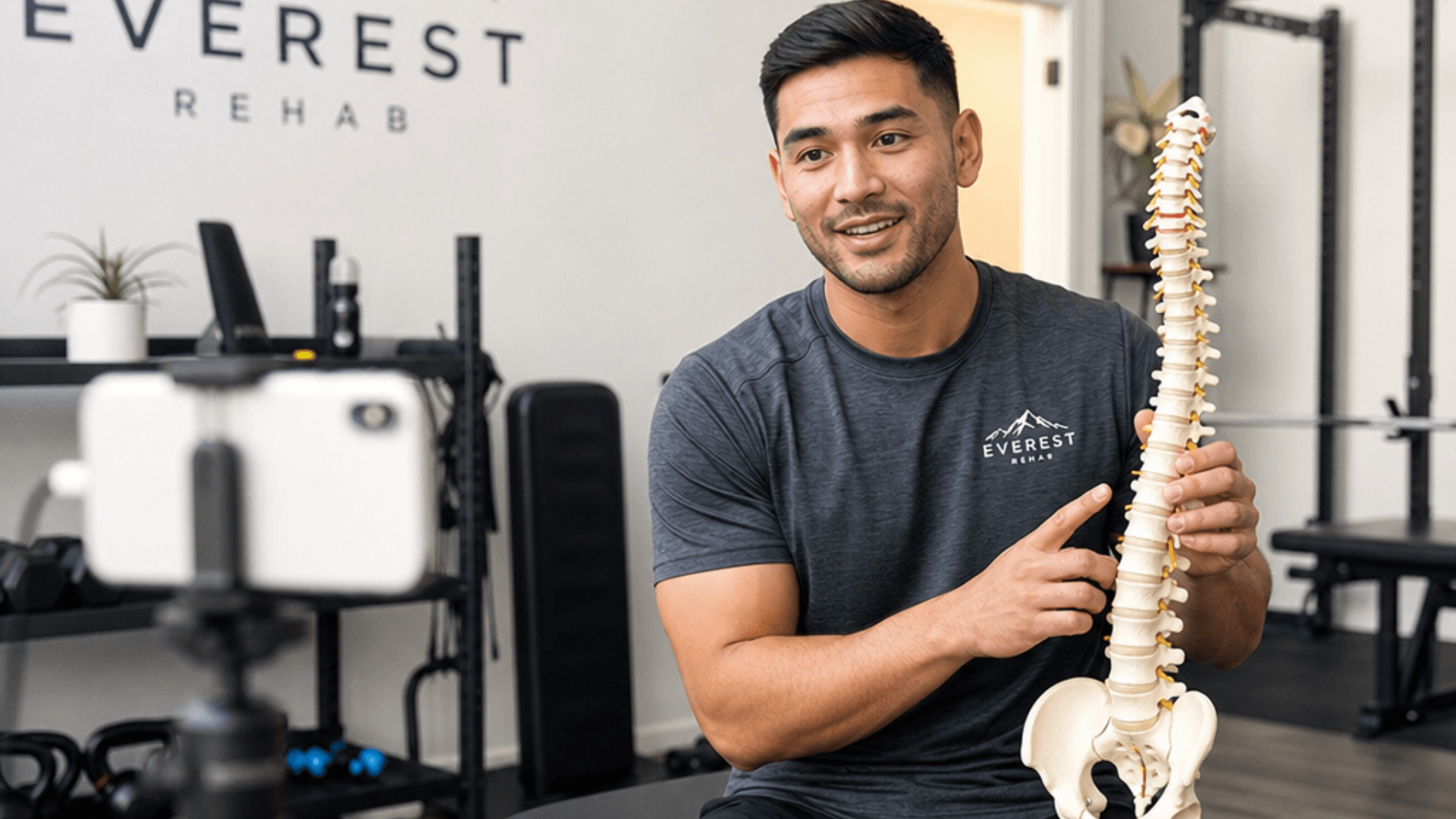
Clinicians who already use Physitrack can record custom exercises with PhysiAssistant at the point of care and add them directly to a patient’s program. A separate clean recording without patient details can also become an Instagram clip. One recording session can therefore support patient instruction and content production without mixing the two audiences.
Common injury myths
Myth-focused posts earn shares because followers send them to someone who has repeated the same claim. Choose a narrow statement such as “knee pain always means you should stop squatting,” then explain when the claim fails and what factors a physical therapist would assess. Precise explanations build more trust than sweeping declarations about the correct way to treat an injury.
Patient success stories
Patient stories show prospective patients what care can involve and what progress may look like. Focus on the patient’s starting problem, the treatment approach, and the functional change that mattered to them. Obtain written authorization before sharing any identifiable image, video, diagnosis, testimonial, or treatment detail. If consent remains unclear, use a fully de-identified composite example instead of the patient’s story.
Behind-the-scenes clinic life
Behind-the-scenes posts reduce uncertainty about visiting your clinic. Show how you prepare a treatment space, introduce staff roles, explain what happens during an initial evaluation, or share a brief view of continuing education. Prospective patients can see the setting and understand the appointment process before they book.
Rotate these pillars according to your niche. A sports rehab account might publish more movement demonstrations and return-to-sport stories, while a pelvic health account may rely more heavily on education and myth correction. Your niche determines which topics deserve repetition, but each post should still give the viewer a useful reason to save, share, or visit your profile.
Why Reels beat static posts for healthcare accounts
Reels should carry most of your Instagram content because Instagram can recommend public Reels to people who do not follow you. Static posts usually depend more heavily on existing followers, search, or shares for distribution. Broader recommendation gives exercise demonstrations and injury myth-busting a better chance of reaching prospective patients who are already watching related videos.
Short-form video also fits the way physical therapists teach. A viewer can see knee position during a squat or watch you correct a common mobility mistake within seconds. Patient stories and clinic footage can become Reels too, provided you have appropriate written authorization for any identifiable patient content.
Start with two Reels per week and increase to three only if you can maintain the pace. Record several clips during one short filming session, then add a clear opening line that names the problem. For example, “Three reasons your shoulder hurts during an overhead press” tells viewers immediately whether the video applies to them.
A phone provides sufficient video quality for most clips. Use steady vertical footage, clear lighting, and readable on-screen text. Keep the demonstration easy to follow and remove pauses that slow the explanation. Clear clinical teaching will usually serve your account better than elaborate editing.
Static content still supports the account. Use carousels for step-by-step education that readers may save and Stories for reminders or informal clinic updates. Let Reels handle discovery while those formats give interested viewers more reasons to follow.
Posting cadence and a sustainable content calendar
A sustainable Instagram cadence starts with three feed posts per week. Publish an exercise or technique Reel early in the week, then share a myth-busting Reel a few days later. Alternate between a patient success story and a behind-the-scenes post for the third slot. Use Stories for quick clinic updates, reposts, and appointment reminders when time allows.
Batch filming reduces the work required to maintain that rhythm. Set aside 45 minutes every two weeks and record several demonstrations in the same space. Change your camera angle or clothing if you want the clips to feel separate. Store edited drafts with their captions so publishing takes minutes rather than becoming another weekly project.
A simple calendar should record the publishing date, content pillar, topic, format, and call to action. Planning four weeks at a time makes gaps visible and prevents one pillar from dominating. Keep two evergreen demonstrations ready for weeks when patient care leaves little time for content creation.
Consistent publishing gives Instagram regular engagement signals and gives followers repeated opportunities to save, share, or respond to your work. Posting seven times during a quiet week and then disappearing for a month produces fewer sustained interactions than a steady schedule. If three weekly posts become difficult, reduce the cadence to two rather than abandoning it. A schedule you can maintain for six months will teach you more than a demanding plan you drop after three weeks.
Writing captions and alt text that show up in Instagram search
Instagram search relies on clear language that matches what prospective patients type. Write captions around symptoms, injuries, body parts, and services instead of internal clinical terminology alone. A runner may search “knee pain when running” rather than “patellofemoral pain.” Include both phrases naturally when both accurately describe the post.
Put the main search phrase near the start of the caption. A squat video could open with “Three squat modifications for people with knee pain,” then explain who may find the demonstration useful. Add your specialty and location where relevant, such as “sports physical therapy in Austin.” Avoid repeating the same phrase until the caption becomes difficult to read.
Alt text should give an accurate description of the image or video for someone using a screen reader. For example, write “Physical therapist demonstrates a supported split squat for knee rehabilitation” rather than “exercise video.” Relevant body-part and exercise terms belong in the description when they reflect what appears on screen. Do not turn alt text into a string of keywords.
Use hashtags to narrow the audience rather than chase the largest possible reach. Combine a niche tag such as #ACLRehab with a local tag such as #AustinPhysicalTherapy. Broad tags like #fitness can attract viewers who have little interest in becoming patients.
Geotag posts with your clinic, neighborhood, or city when the content supports a local service. A viewer who finds a useful Reel through a local search can then visit your profile, confirm that you treat their problem nearby, and follow the booking link. Keep the same specialty and location language across your bio, captions, hashtags, and geotags so each part of the account points toward the patients you want to reach.
Handling HIPAA and patient consent in every post
Protected health information includes health details that identify a patient or give someone a reasonable way to identify them. A face or name qualifies, but so can a voice, tattoo, appointment date, clinic room sign, or unusual injury described with local context. Blurring a face does not make a post anonymous when other details reveal the patient.
A HIPAA-covered clinic should obtain a written authorization before publishing an identifiable patient story, progress photo, testimonial, or treatment clip. General treatment consent usually does not authorize social media use. The authorization should specify the content, the Instagram account, the intended use, and when permission expires. It should also explain that the patient may refuse without affecting care and may revoke permission for future use.
Use the same pre-post check for every patient-related post.
- Confirm that a signed authorization covers the exact photo, video, quotation, or clinical story you plan to publish.
- Remove unnecessary identifiers, including names, dates, visible paperwork, and spoken details in the background.
- Check whether the authorization covers organic posts, paid ads, Stories, and reuse on other channels.
- Explain that revocation stops future use but may not remove copies that other Instagram users have saved or shared.
- Ask another staff member to review the final post against clinic policy and applicable state privacy rules.
When authorization is absent, replace the case with a fictional composite or teach the concept without patient details. Clinicians should also keep diagnosis discussions and other clinical communication out of Instagram DMs. Move those conversations to an approved secure channel rather than asking a follower to share personal health information through social media.
Measuring what's actually working
Measure each post by the action it should produce. Likes show quick approval, while saves indicate that someone expects to revisit an exercise or explanation. Shares extend the post to another potential patient, and profile visits show that the content prompted someone to evaluate you or your clinic.
Judge each content pillar against a different pattern. Exercise demos and myth-busting posts should generate relatively strong save and share rates. Patient stories should drive more profile visits, while behind-the-scenes posts may earn comments and direct messages from people considering care. No single ratio applies to every account. Your previous four weeks provide a more useful baseline because they reflect your audience size, niche, and local market.
Review Instagram Insights for 15 minutes at the same time each week. Record each post’s format and topic, then add reach, saves, shares, profile visits, and booking-page taps to a simple spreadsheet. Calculate saves and shares as a percentage of reach so a larger audience does not automatically make one post appear more effective.
Use the review to choose one adjustment for the following week. You might repeat a knee exercise format that earned strong saves, rewrite an opening line that lost viewers, or add a clearer booking prompt to a Reel that drove profile visits. Compare similar posts over several weeks before dropping a topic, since one weak result may reflect timing rather than subject matter.
Turning followers into booked appointments
Your profile should make booking possible within a few taps. Write a bio that names your specialty and service area, then send the link to a mobile-friendly booking page. If patients cannot schedule online, direct them to a short appointment request form instead. Avoid a link page crowded with unrelated resources.
Local discovery should lead prospective patients to a relevant service. A runner who finds your knee pain Reel through a sports rehab hashtag or clinic geotag should reach a profile that clearly offers running injury assessments nearby. Use location tags on clinic posts, and combine a few local hashtags with terms tied to your niche. Broad tags such as #physicaltherapy may bring views, but they rarely indicate local booking intent.
Fast DM responses prevent interested viewers from losing momentum. Check messages daily, and create saved replies for common questions about availability, insurance, and appointment requests. Move clinical discussions to an approved private channel rather than asking someone to share health details through Instagram. A useful reply gives the next step directly, such as “We treat this type of shoulder pain at our Austin clinic. You can request an evaluation through the link in our bio.”
Each caption and Story should give the viewer one relevant action. For example, close a Reel with “Dealing with ankle pain after running? Use the link in our bio to schedule a running assessment in Austin.” Stories can pair the same message with a link sticker or a prompt such as “Reply RUNNING and we’ll send booking information.”
Track how many profile visits become link clicks, DMs, and appointment requests. Add “How did you hear about us?” to your intake form so Instagram bookings do not disappear into general referral numbers.
FAQ
What is the minimum posting frequency?
A sustainable posting frequency is the schedule you can maintain without long gaps. For a physical therapy account, two useful posts per week provide a reasonable starting point, with at least one Reel. A steady schedule lets you compare results and build a reusable content library.
Do patient faces need to be blurred?
De-identification removes faces and other details that could reveal a patient’s identity. Your clinic may show an identifiable patient only with valid written authorization that clearly covers social media use. Blurring faces, removing names, and checking backgrounds can help de-identify content, but you must remove every detail that could reasonably identify the patient.
What should I do when growth plateaus?
A growth plateau occurs when reach and follower counts remain flat across several weeks. Your physical therapy account should review saves, shares, profile visits, and retention to identify which topics and openings hold attention. Repeat the strongest topic in a new format before increasing posting volume.
Do I need paid ads early on?
Paid ads buy targeted distribution beyond the audience Instagram reaches organically. A new physical therapy account should first test its niche, content, profile, and booking path through regular posts. Organic testing helps you avoid spending money on content or offers that have not produced inquiries.
The takeaway for building a PT presence that pays off
Instagram growth follows consistent, useful education for a specific patient audience. Choose a clinical niche, publish clear Reels regularly, write searchable captions, protect patient privacy, and guide interested viewers toward booking. Saves, shares, profile visits, and appointments show whether that work reaches the right people.
Your everyday clinical explanations already provide the raw material. Exercise demonstrations, injury misconceptions, and technique corrections can become short posts with a phone camera. PhysiAssistant can help clinicians record custom exercise videos at the point of care, which can also inspire social content when no patient information appears. A repeatable filming habit turns existing expertise into an Instagram presence that supports patient acquisition and professional reputation.