Clinic Management Software Isn't Enough: Adding Exercise Prescription and Patient Engagement for Multi-Branch Clinics in India
Resumo
- Clinic management software like PhysioCare PMS and Adrine handle scheduling, patient records, and billing well, but it does not deliver exercise prescription, home exercise programs, adherence tracking, or telehealth.
- Physitrack adds that engagement layer on top of your existing PMS. It connects to EMR and PMS systems including Epic rather than replacing your scheduling or billing.
- You keep your current operational workflow and layer patient engagement and outcomes tracking over it.
- The added cost is ₹1,100 per clinician per month.
- Physitrack supports 15+ languages, which lets multi-branch clinics standardize patient engagement across a linguistically diverse patient base.
The gap in clinic management software
Clinic management systems like PhysioCare PMS and Adrine are built to run the business side of a practice, and they do it well. They handle appointment booking, patient records, invoicing, and the scheduling logic that keeps multiple branches from double-booking the same clinician. For a multi-branch operator in India, that coverage is the operational backbone. You need to know who is booked where, what was billed, and which records belong to which patient across every location.
The category boundary sits at the clinic door. A PMS is designed to manage what happens inside the practice, so its scope ends once the patient leaves with a plan for the week ahead. Exercise prescription, home exercise programs, adherence tracking, and video consultations fall outside what scheduling and billing software was ever meant to do. That is not a shortcoming of the PMS but a different job.
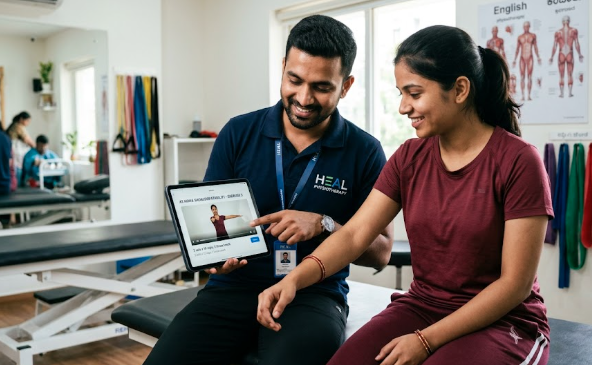
Most clinics still deliver the clinical part of care the old way. A physiotherapist demonstrates exercises in the room, then sends the patient home with a printed handout or a few photos on a phone. Once the patient walks out, you have no visibility into whether they did the exercises, whether they did them correctly, or whether they gave up by day three. When the patient returns two weeks later reporting no progress, you are guessing at the cause.
Telehealth sits in the same blind spot. A PMS can schedule a follow-up, but it cannot host the video consultation, deliver an updated program during the call, or capture a patient-reported outcome measure afterward. For clinics serving patients across a wide catchment or managing chronic caseloads, that missing layer means every follow-up requires a physical visit or an untracked phone call.
Physitrack fills that space rather than competing for it. Your PMS keeps running scheduling and billing exactly as it does now, and the exercise prescription, adherence data, and telehealth layer sits on top. The two work alongside each other, so you add patient engagement without touching the operational system your staff already know.
What your PMS covers vs. what Physitrack adds
Your practice management system and Physitrack answer two different questions. The PMS manages the business of running clinics. Physitrack manages what the patient does between visits and how you track whether it worked.
The two columns rarely overlap. PhysioCare PMS and Adrine both handle the left side well, which is exactly why they sell. Neither is built to prescribe an exercise, show a patient a video of it, or tell you three weeks later how many sessions that patient actually completed. That work still lands on paper handouts or gets skipped, which is the gap Physitrack fills.
Physitrack connects to your existing EMR and PMS systems, including Epic, rather than replacing them. You keep your current scheduling and billing workflow exactly as it is, and you layer exercise prescription, adherence data, and telehealth on top. Your front desk books the same way tomorrow as it does today. The change your patients notice is a program they can follow at home and a clinician who can see whether they followed it.
Why multi-branch clinics in India need to standardize engagement
When you run three or five branches, each location tends to develop its own habits around exercise prescription and follow-up. One branch hands out photocopied sheets. Another texts video links from a personal phone. A third relies on whatever the treating clinician remembers to say at discharge. That variation means two patients with the same diagnosis get two different rehab experiences depending on which door they walked through.
The cost shows up in outcomes you cannot see. A PMS records that a patient attended six sessions and paid for them, but it says nothing about whether that patient did their home program between visits. Without a shared method for prescribing exercises and tracking adherence, you have no way to compare recovery across locations or spot the branch where patients quietly stop following through. Standardizing the engagement layer gives you one prescription library, one adherence signal, and one set of patient-reported outcome measures that read the same in Chennai as they do anywhere else in the network.
The practical obstacle to standardizing across India is language. A single clinic often treats patients who speak Tamil, Hindi, English, and more, and a printed sheet in the wrong language gets ignored. Physitrack delivers home exercise programs through PhysiApp in 15+ languages, so a clinician prescribes once and the patient reads the instructions in the language they actually use at home. That turns a standard protocol into something every patient can follow, which makes consistency across a diverse patient base workable.
Standardizing does not flatten clinical judgment. Each clinician still chooses the program. What changes is that every branch works from the same library and the same tracking, so your network reports on care as one practice instead of several.
Evaluating the stack: pricing, security, and certifications
Physitrack costs ₹1,100 per clinician per month, which lands as a small line item next to what you already spend running PhysioCare PMS, Adrine, or a similar system. You are paying that PMS to handle scheduling, patient records, and billing. The ₹1,100 buys the engagement layer that sits on top, covering exercise prescription, home exercise programs through PhysiApp, adherence tracking, telehealth, and PROMs. Building the business case is straightforward when you count clinicians rather than branches, since the price scales per active clinician regardless of how many locations you run.
For a five-branch clinic with twelve clinicians, that works out to a predictable monthly figure you can model against the outcomes you expect to track. The cost does not replace anything in your current stack, so you are not weighing it against your PMS subscription. You are adding it alongside.
Hospital outpatient departments and multi-branch procurement teams will ask about data security before they approve any new patient-facing tool, so the certifications carry as much weight as the price. Physitrack holds ISO 27001 for information security management and ISO 13485 for medical device quality management. Those two standards answer the questions a hospital IT or compliance reviewer raises when patient data moves through a new platform. ISO 27001 covers how patient information is stored, accessed, and protected. ISO 13485 covers the quality processes behind the software itself.
When you take the proposal to a procurement committee, lead with the two certifications and the per-clinician price. A reviewer who already trusts your PMS for records and billing can approve an additive engagement layer quickly when the security posture is documented and the cost is bounded to a known number.
Giving every branch a single branded patient experience
A branded app gives multi-branch operators one consistent way for patients to receive their home exercise programs, message their clinician, and book follow-ups, regardless of which location they visited. Without it, one branch might hand out a paper sheet, another might text a video link, and a third might send patients to a generic third-party app. That inconsistency is visible to patients, and clinic owners lose any single view of adherence across sites.
Physitrack's branded app comes in three tiers. The Lite tier is live now on a two-year contract and reaches app store readiness in about six weeks. It supports up to 500 active patients and covers the branded app, the exercise library, adherence tracking, and branded telehealth. For a two- or three-branch clinic standardizing patient engagement for the first time, Lite covers the essentials.
The Pro tier adds video consultations, custom intake forms, outcome measures, and unlimited patients, and it launches at the end of April 2026. The Enterprise tier extends further with multi-site and multi-brand support plus EMR and EPR integration, which fits larger networks running several brands or hospital outpatient departments. Onboarding to launch a branded app takes roughly six weeks in every case, so plan for a short setup window rather than same-day activation.
Jonathan Clark Physiotherapy shows what Lite looks like in practice. The group runs five clinics with 20 staff and sees around 1,000 patients a month. It uses Branded App Lite as a single front door that links booking, its website, and patient reviews inside one consistently-branded experience. A patient at any of the five locations opens the same app, sees the same identity, and follows the same path from booking through their exercise program.
For a multi-branch clinic in India, that consistency does real work. Every branch prescribes exercises through the same library, tracks adherence the same way, and delivers telehealth under your clinic's name rather than a vendor's. The branded app is a supporting layer on top of the exercise prescription and engagement tools, not a reason to adopt them on its own. If you already plan to standardize engagement across locations, it turns that standard into something patients can see and recognize.
Adding the engagement layer without disrupting your PMS
Adding Physitrack alongside your existing setup is a sequencing decision, not a migration project. You keep your current scheduling, records, and billing exactly as they are. Physitrack sits on top of that operational layer and handles exercise prescription, adherence tracking, and telehealth. Nothing in your PhysioCare PMS or Adrine workflow gets rebuilt or moved.
Start by connecting your existing systems. Physitrack integrates with EMR and PMS platforms including Epic, so patient records and appointment data flow without duplicate entry. Your front desk still books through the same tool, and your billing runs on the same rails. Clinicians simply gain a new place to prescribe programs and monitor how patients follow them at home.
Roll out the engagement layer branch by branch rather than switching every location at once. Pick one branch, train its clinicians on program building and adherence tracking, and let them run live patients before you expand. Once that branch is confident, repeat the process at the next location using the same standardized library and workflow. A staged rollout lets each branch adopt the same practices, so no location loses a day of operations during the change.
Because you are adding a layer rather than replacing a system, your team keeps working in familiar tools throughout. The only new habit clinicians learn is how to prescribe and track exercise inside PhysiApp.
Como começar
You already have the operational side handled. Your PMS runs scheduling, records, and billing, and your team knows it. The next move is adding exercise prescription, adherence tracking, and telehealth on top, without touching the workflow you rely on.
Book a demo with Physitrack to see how the engagement layer connects alongside your current system. Bring your setup to the call. Show your team the 18,000+ exercise video library, PhysiApp home program delivery, and PROMs working against a real patient scenario, then decide whether the branded app or a standard rollout fits your branches better.
Start with one location, prove the outcomes tracking, and expand from there. At ₹1,100 per clinician per month, the business case is easy to build before you commit across every branch.
Perguntas frequentes
Does Physitrack replace my clinic management software?
No. Physitrack adds exercise prescription, adherence tracking, and telehealth on top of your existing system. Your PhysioCare PMS, Adrine, or other PMS keeps running scheduling, patient records, and billing exactly as it does today.
How does Physitrack connect to my existing EMR or PMS?
Physitrack integrates with EMR and PMS systems, including Epic, so your scheduling and billing stay in place. Clinicians prescribe home exercise programs and track adherence in Physitrack while the rest of your operational workflow continues in the system your staff already knows.
How long does it take to launch a branded app?
Onboarding takes about six weeks to reach app store readiness, so a branded app is not an instant-activation feature. The Branded App Lite tier is live now on a two-year contract and covers up to 500 active patients, with the branded app, exercise library, adherence tracking, and branded telehealth. The Pro tier adds video consultations, custom intake, outcome measures, and unlimited patients, launching end of April 2026.
How does pricing scale across multiple branches and clinicians?
Physitrack costs ₹1,100 per clinician per month in India, so your spend scales with the number of clinicians rather than the number of branches. A multi-branch clinic pays per active clinician across all locations, which keeps the added engagement layer a predictable line item against your existing PMS budget. For larger networks, the Enterprise tier adds multi-site and multi-brand support along with EMR and EPR integration.
.png)

