Find It Before You Finish Typing: Introducing AI Exercise Search
Resumo
- AI Exercise Search lets you describe what you mean and find the exercise before you finish typing, across Physitrack's 18,000+ exercise library.
- It understands plain language and precise clinical terms, tolerates typos instead of returning a dead 0-results screen, and ranks the most relevant exercise first.
- The feature is live now for every Physitrack clinician, with no gated rollout and no waitlist.
- Mais de 110.000 profissionais de saúde já utilizam a Physitrack para elaborar e prescrever exercícios domiciliares.
Desenvolvido com os mesmos padrões dos melhores softwares que você utiliza.
Physitrack builds the way top consumer software builds. When you open your phone and start typing, search anticipates you. It reads intent, forgives a typo, and puts the right result first. Physitrack holds its clinical library to that same standard, because a physical therapist searching mid-consult deserves the product intelligence they already expect from the best tools they use every day.
The Physitrack library now holds 18,000+ exercises, and that scale is exactly why search intelligence carries so much weight. A large library rewards a clinician only when the right exercise inside it surfaces fast. A bigger library you cannot search quickly is just a bigger haystack.
That principle drives how Physitrack approaches search. You should describe what you mean and let the system understand it, whether you type a plain phrase or precise clinical terminology. You should reach the exercise you want without pausing to recall a specific stored label. AI Exercise Search applies modern product standards to a clinical library, so finding the right movement feels as immediate as the search you rely on outside of work.
Introducing AI Exercise Search
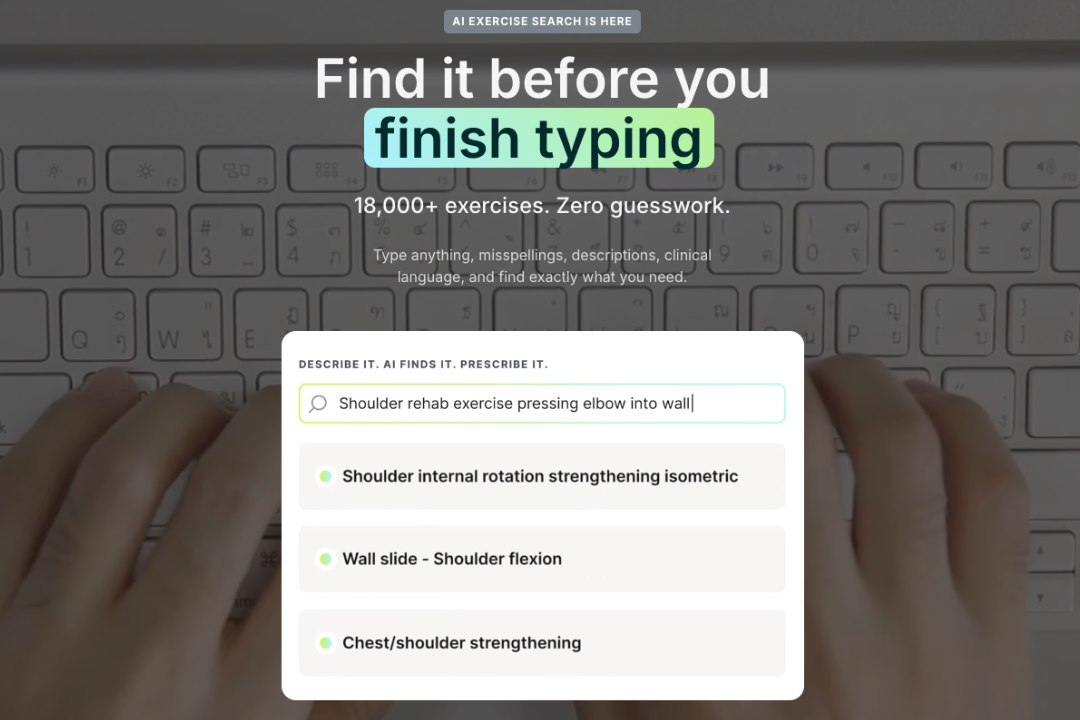
We built AI Exercise Search to bring the kind of search intelligence you expect from the best consumer software into a clinical exercise library. Type a few words and the right exercise surfaces before you finish, the same responsiveness you get from the top-tier products you use every day outside of work.
That standard shapes how we build. Rather than treating an 18,000+ exercise library as a list you scroll and filter, we designed search to keep pace with how you actually think during a consult, moving at the speed of the conversation in front of you.
AI Exercise Search works across three pillars. It understands what you mean, it forgives how you type, and it puts the most relevant exercise first. The next section shows each one at work inside a real clinical moment.
Three ways AI Exercise Search changes the workflow
It understands what you mean, not just what you type. A patient describes tight hamstrings after a long drive, and you type "my back hurts" while you're still turning back toward the screen. AI Exercise Search reads the intent and surfaces relevant options. Type precise clinical language instead, like "quadricep strengthening in supine," and it lands the same way. You describe the exercise you have in mind, and you stop reverse-engineering the one word the library expects you to use.
It tolerates typos, so a slip mid-consult never dead-ends. You're mid-sentence with a patient, one hand on the keyboard, and you mistype a term. Older keyword search returns a blank "0 results" screen, and now you're deleting characters and squinting at your own spelling while the patient waits. AI Exercise Search reads through the error and returns the exercises you were reaching for. The consult keeps moving because a single dropped letter no longer sends you back to the search bar.
It ranks results by relevance, so the right exercise sits at the top. A search for a common movement can pull thirty near-identical variations, and the one you actually want gets buried four scrolls down among slight grip changes and equipment swaps. AI Exercise Search puts the most relevant match first instead of dumping every partial keyword hit in whatever order the library stored them. You confirm the exercise at a glance and prescribe it, rather than scanning a long list to decide which variation the system meant.
Why this matters beyond convenience
Every minute you spend hunting for the right exercise is a minute you are looking at a screen instead of your patient. In a 30-minute session, a search that makes you try three different terms before it finds a straight-leg raise pulls your attention out of the encounter at exactly the moment the patient needs it. Search that responds to what you mean returns you to the conversation faster, and that recovered attention is where clinical work actually happens.
The naming problem is real, and it gets worse the further Physitrack travels. The same movement carries different names across countries and clinical traditions, so a clinician trained in one system types a term the library files under another. Physitrack serves clinicians in 174 countries, which means the library holds many exercises under names shaped by where and how a clinician learned. Search that matches meaning rather than exact wording lets a clinician in São Paulo and a clinician in Manchester both find the same exercise without knowing the platform's preferred label for it.
That same behavior removes a workaround clinics have leaned on for years. When search could not be trusted to surface the right exercise on demand, the fix was to build large template libraries so the exercises you actually use sit pre-assembled and out of the search path. Templates still earn their place for standardized protocols and common conditions. Building them purely to route around unreliable search is a maintenance cost you took on because the tool left you no better option.
AI Exercise Search changes that calculation. When you can describe an exercise and find it in one attempt, you no longer need a template as a search substitute. You keep the templates that reflect genuine clinical protocols, and you drop the ones that existed only to compensate for search you could not rely on. For a clinic director, that means less time spent maintaining sprawling template sets across a team, and more of that team's attention spent inside patient care rather than inside the software.
A bigger library is just a bigger haystack
A library of 18,000+ exercises only pays off when a clinician can reach the right one in seconds. Content volume and search intelligence are two different engineering problems, and much of the category has invested in growing the first. Physitrack builds against the standard set by leading consumer technology, where you expect a product to understand what you mean the moment you start typing.
AI Exercise Search applies that standard to a clinical library at scale. A bigger library is just a bigger haystack unless the software can put the right exercise in front of you first. Physitrack treats search as core product intelligence, so the size of the library becomes a genuine advantage rather than a longer list to scroll through.
That ambition drives how Physitrack approaches the whole platform. The company builds ahead of the category, benchmarking the search experience against the top-tier software clinicians already use every day outside work. Scale and intelligence advance together here, and AI Exercise Search is what happens when both meet inside one clinical library.
Built and validated with clinicians
We built AI Exercise Search alongside clinical beta partners, including a leading U.S. academic medical center whose therapists tested it against the searches they run during real sessions. Their feedback shaped how the feature reads plain descriptions, handles typos, and ranks results, so the version you use today reflects how clinicians actually search rather than how a database expects to be queried.
That testing sits on top of the scale Physitrack already serves. More than 110,000 clinicians across 174 countries prescribe home exercise programs on the platform, which means the naming and phrasing differences across clinical traditions showed up in testing rather than after launch.
AI Exercise Search is live now for every Physitrack clinician. There is no gated rollout, no waitlist, and nothing to enable. Open the exercise library on your next program and start typing.
Try AI Exercise Search today
AI Exercise Search is live right now for every Physitrack clinician, with no waitlist and no gated rollout. Open the search bar, describe the exercise in your own words, and let the results catch up to you. Whether you type a plain patient complaint or precise clinical language, the right exercise surfaces at the top instead of buried under near-identical variations.
See how AI Exercise Search works and put it to use in your next session.
Find it before you finish typing.