Will AI Replace Physical Therapists? The Honest Answer
TL;DR
- AI will not replace physical therapists. Software cannot palpate tissue, read pain behavior, adapt hands-on treatment as a patient moves, or build trust in the room.
- AI can reduce time spent on documentation, exercise program building, home exercise personalization, remote monitoring review, and intake screening because those tasks use structured information.
- Physical therapists who adopt AI may outpace those who avoid it. Recovered admin hours can support more patient visits, more timely documentation, and less charting after work.
The fear is reasonable, and here's exactly where it comes from
Clinicians have a reasonable basis for worrying about AI. Headlines describe algorithms detecting abnormalities in medical images, models suggesting diagnoses, and documentation bots turning recorded visits into clinical notes. Because each of these tasks once required substantial professional judgment or labor, clinicians can reasonably ask which parts of physical therapy might be automated next.
Radiology and diagnostic algorithms usually work with bounded inputs and defined outputs. A model can examine an image for patterns associated with a finding, or compare structured symptom data with patterns in previous cases. Documentation software handles a similar task by converting speech and clinical details into a familiar note format. Large datasets allow these systems to predict a likely classification or sequence of words.
Physical therapy includes some tasks with a similar structure, which makes parts of the concern valid. AI can assist when information follows repeatable categories, such as recorded symptoms, exercise selections, or note fields. However, a physical therapy session also depends on information that software cannot obtain through a chart or camera alone. A physical therapist feels resistance, notices subtle guarding, tests a response, and changes course while speaking with the patient.
AI headlines often blur that distinction by treating every clinical task as another prediction problem. Pattern recognition can support a physical therapist when the relevant information can be captured and compared. It cannot reproduce clinical work that depends on touch, physical presence, and a relationship with the patient.
The line between what AI can do and what it can't
AI can reduce the time spent on structured work because these tasks have repeatable inputs and expected outputs. Documentation tools can turn a recorded clinical encounter into a draft note. Program builders can match stated goals and limitations with appropriate exercises, while home exercise personalization tools can adjust parameters using reported progress. AI can also review remote therapeutic monitoring data for changes and sort intake responses for triage.
Those tasks share a common structure. Software receives text, measurements, or predefined choices and compares them with patterns learned from earlier examples. The clinician still checks the output and remains responsible for the decision, but AI can complete much of the initial sorting, drafting, and searching faster than a person working manually.
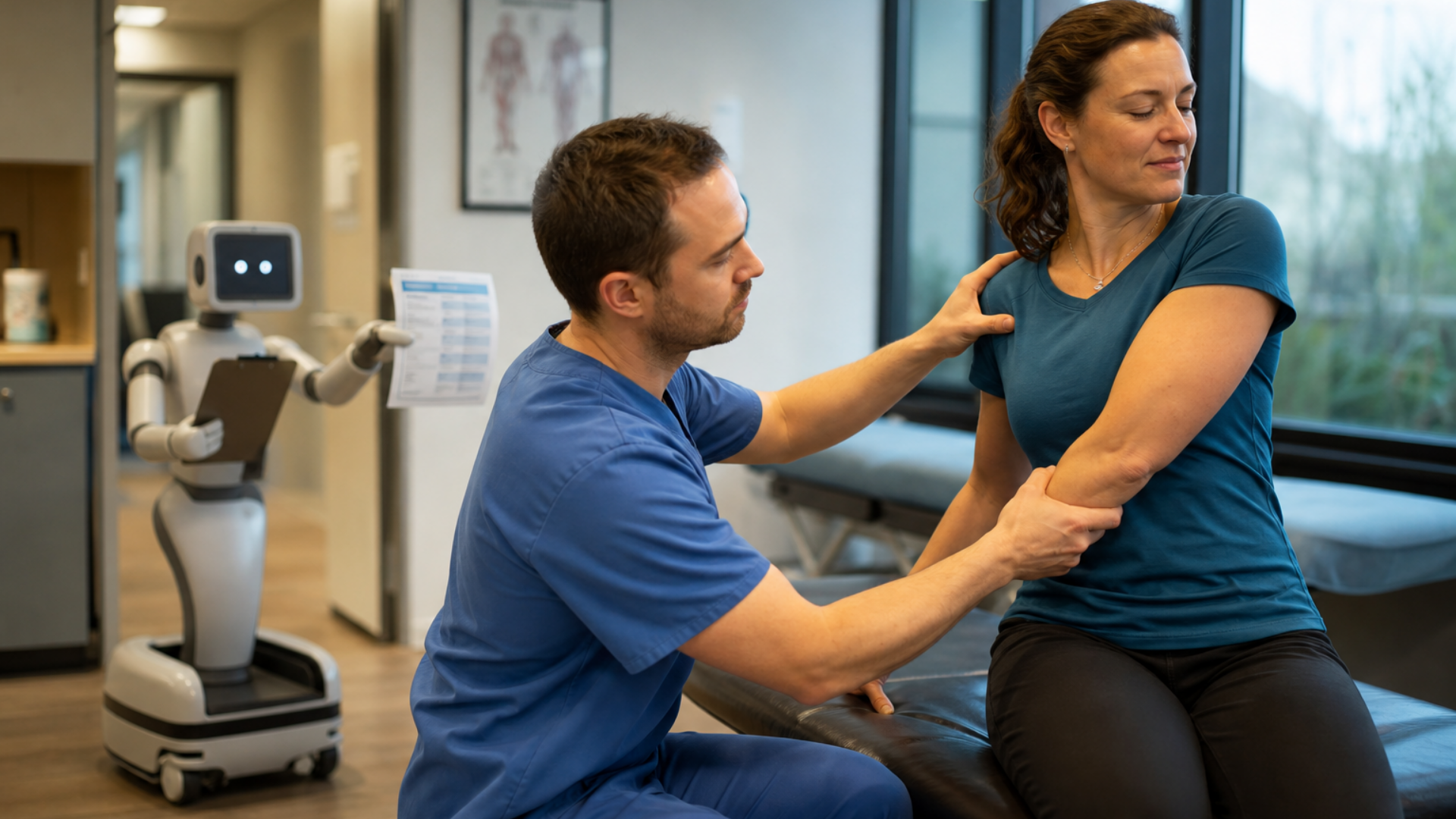
Hands-on physical therapy depends on information that software cannot directly access. During manual therapy or palpation, a physical therapist feels how tissue responds and notices whether the patient guards before reporting pain. The physical therapist also reads movement, facial expression, tone, and hesitation together, then changes the assessment or treatment based on what happens in that moment. A patient may perform the same movement differently because of fear, fatigue, or a recent flare, even when the chart looks unchanged.
Statistical prediction cannot reproduce that clinical exchange because the relevant information develops through physical contact and interaction. A model can estimate what a finding might mean based on recorded examples, but it cannot feel resistance under its hand or test whether a different cue changes the patient's movement. Sensors and cameras can add useful observations, but the physical therapist must decide which observation matters and whether the patient's response supports the working explanation.
The therapeutic relationship creates another firm boundary. Adherence often depends on whether a patient trusts the plan, feels understood, and believes the prescribed work fits daily life. AI can send reminders or explain an exercise, but a physical therapist earns trust by responding to uncertainty and adjusting expectations through repeated human contact.
AI therefore fits the parts of physical therapy that convert structured information into drafts, recommendations, or alerts. Physical therapists remain responsible for the tactile assessment, real-time clinical reasoning, treatment adaptation, and relationship that turn those inputs into care.
Why hands-on skill isn't a data problem
Hands-on clinical judgment develops through a physical feedback loop between a physical therapist and a patient. The physical therapist guides a movement or applies touch and then uses the felt response to choose the next action. AI works best when relevant signals already exist as standardized inputs. A camera, questionnaire, or wearable captures only part of what the physical therapist senses in the room.
A patient with knee pain may arrive more guarded than at the previous visit. During a planned squat progression, the physical therapist sees the patient unload the affected side and hears a change in breathing. The therapist pauses and tests a different load. The patient’s immediate response determines whether the therapist continues, modifies the movement, or abandons that approach for the day.
For AI to make the same decision independently, the software would need to capture the full clinical state, including tactile signals such as tissue resistance and subtle protective tension. The software would then need to test an intervention safely while interpreting the patient’s response in context. Pattern matching can estimate a likely response based on prior cases, but it cannot perform an embodied examination. More training data cannot supply sensations that the software never acquires.
Trust adds information that no intake form can fully capture. A patient may disclose fear only after a physical therapist notices hesitation and responds without dismissing it. The therapist can then set a tolerable challenge and earn the patient’s consent for progression. That trust supports adherence because the patient experiences the plan as responsive to their condition. AI can organize recorded information, but the physical therapist creates the in-room conditions that make honest feedback and sustained participation possible.
The real risk isn't replacement—it's falling behind
The competitive risk comes from physical therapists who use AI well, not from AI working independently. AI can absorb structured administrative work while the clinician retains responsibility for assessment, treatment decisions, and patient communication. Clinics that manage that division carefully can increase capacity without reducing the time or attention each patient receives.
Recovered minutes become meaningful when they accumulate across a full schedule. Suppose an AI documentation tool saves eight minutes per visit. Across eight visits, the clinician recovers more than an hour that could support another appointment, same-day note completion, or an earlier end to the workday. The value comes from how the clinic uses the time, not from the software producing text faster.
AI can also improve documentation compliance by drafting notes promptly and flagging missing information before submission. The physical therapist still reviews the record for clinical accuracy, but the first draft no longer needs to begin after the last patient leaves. Fewer unfinished charts can reduce billing delays and the routine spillover of work into evenings.
Clinic owners should evaluate AI adoption based on operational results. Useful measures include minutes spent documenting each visit, the number of notes closed on time, and weekly hours spent charting after work. Patient volume should rise only when the recovered capacity supports it without shortening necessary care.
Physical therapists control this risk through selective adoption. Clinicians who assign repetitive administrative work to AI can preserve more time for treatment and clinical reasoning. Clinicians who continue doing every task manually may face higher overhead, less scheduling capacity, and more after-hours work while delivering the same hands-on care.
What this looks like in practice
Physitrack’s AI tools show how software can shorten structured preparation while leaving clinical decisions with the physical therapist. PhysiAssistant lets a clinician film an exercise at the point of care and build a patient program immediately. The clinician still selects the movement, observes the patient’s response, and decides whether the exercise belongs in the plan.
AI Exercise Search reduces the time spent browsing an exercise library for an appropriate option. A clinician can find relevant exercises faster, then assess suitability based on the patient’s diagnosis, current movement, symptoms, and goals. The tool speeds up retrieval without deciding what the patient can safely perform.
Both tools apply AI to program-building work that follows searchable patterns. Neither tool palpates tissue, notices guarding during a repetition, or earns a patient’s trust. By spending less time assembling programs, clinicians can preserve more of the appointment and working day for assessment, treatment, and patient communication.
The honest answer
AI will not replace physical therapists. Physical therapy depends on embodied judgment, patient trust, and clinical decisions for which a qualified human remains accountable. AI can support care, but software cannot assume responsibility for what happens when a patient’s condition, movement, or response does not fit the expected pattern.
Physical therapists who assign bounded administrative work to AI will have more time and attention for patients. They can gain an advantage over clinicians who continue spending evenings on work that software can assist with safely. Adopt AI where it removes clerical effort, verify its output, and protect the hands-on clinical role that patients need.
Perguntas mais frequentes
Which physical therapy tasks will AI automate first?
AI will first automate structured tasks such as documentation, exercise selection, program building, intake screening, and monitoring-data review. Physitrack applies AI to exercise discovery and home exercise program creation while leaving clinical decisions with the physical therapist. You can recover administrative time without handing over patient care.
Is AI accurate enough for physical therapy documentation?
AI can draft documentation, but a physical therapist must verify clinical details, reasoning, and required fields. Physitrack treats AI as clinician support rather than an independent clinical authority. Clinician review prevents an incorrect or incomplete draft from entering the patient record.
Will insurers require AI documentation?
Requirements vary by payer, so clinicians should not assume that using AI satisfies an insurer’s documentation rules. AI can draft or organize notes, but the clinician remains responsible for the final record. Physitrack supports digital clinical workflows without changing that responsibility.
How can physical therapists start using AI without disrupting care?
Physical therapists can begin with one repetitive, low-risk task that already consumes administrative time. Physitrack’s AI Exercise Search offers a practical starting point because it shortens exercise discovery without changing the clinical assessment. A limited trial lets you check accuracy and fit before expanding AI use.
Does AI in physical therapy reduce quality of care?
AI can reduce care quality when clinicians accept its output without review or let software substitute for clinical judgment. Physitrack keeps the clinician responsible for choosing exercises, adapting treatment, and interpreting patient responses. Clinicians can maintain care quality when AI handles preparation and they retain control.