

Virtual Reality in Physical Therapy: What the Evidence Shows
TL;DR
- Evidence supports VR as an adjunct for chronic pain, post-stroke upper-limb recovery, and gait and balance training. A chronic pain review covered 56 randomized trials with 2,993 participants, but study methods varied substantially.
- Evidence remains thinner for orthopedic rehabilitation and long-term outcomes. Published protocols vary enough that clinics should avoid assuming results will transfer across conditions or platforms.
- Fully immersive headsets and semi-immersive projector systems require different capital spending, space, setup, and staff support. Clinics should choose the format before comparing vendors.
- Patient fit can limit use. Vestibular sensitivity, cybersickness, and cognitive demands may affect tolerability. VR can motivate patients and provide objective movement data, while webcam-based home exercise tracking offers a lower-barrier complement.
What counts as VR in physical therapy
Working definition
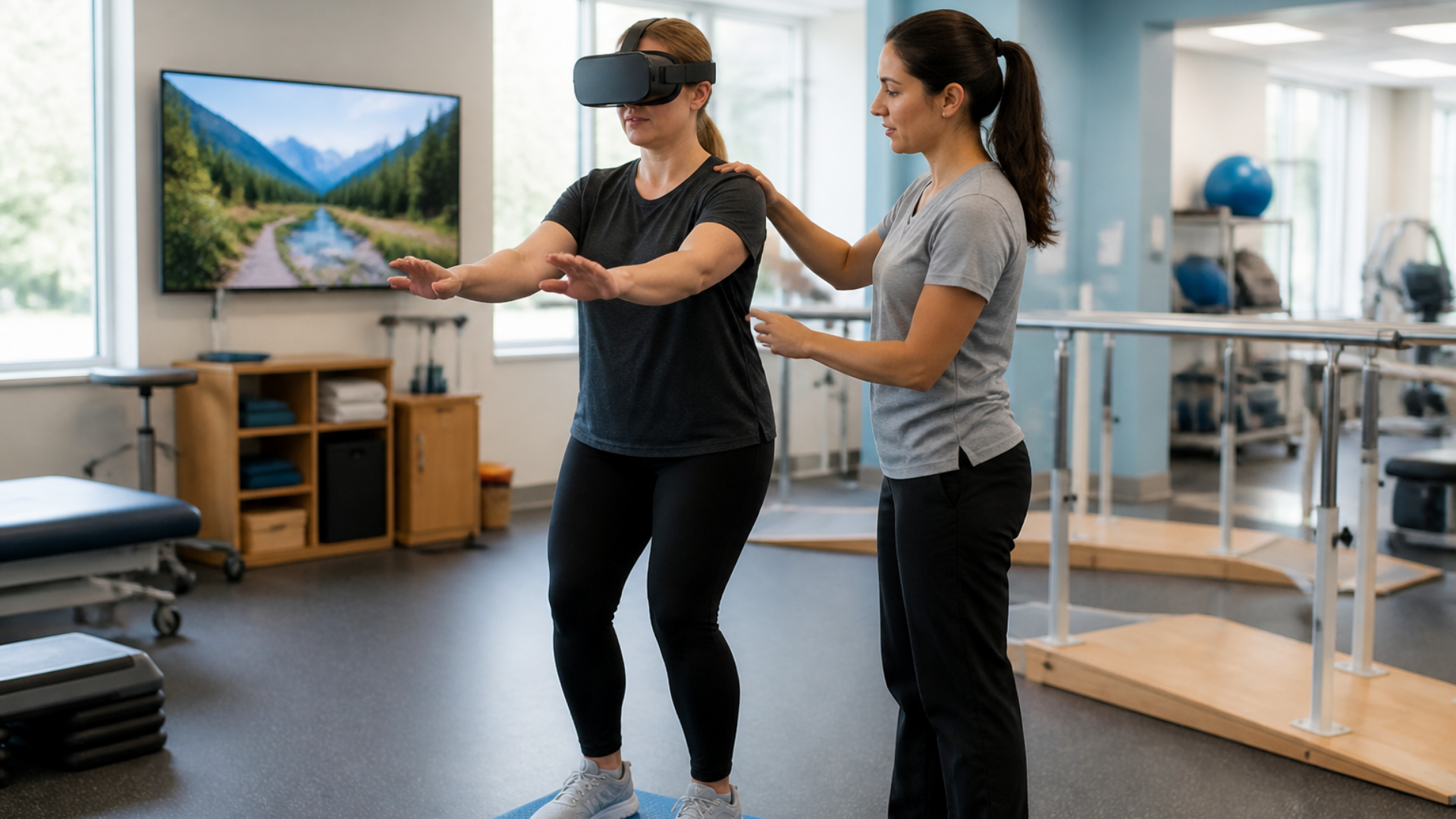
VR rehabilitation uses a computer-generated environment to guide therapeutic movement, provide feedback, or change how a patient experiences a task. The patient may view that environment on a standard screen, through a projected display, or inside a headset.
Clinical descriptions commonly divide VR into three levels of immersion.
Clinics should treat these levels as separate technology tiers when reviewing evidence. A study using a balance board and television does not establish that a headset will produce the same response. Likewise, the broad label “VR rehabilitation” does not reveal the purchase cost, floor space needs, staffing burden, or patient screening required for a specific product.
Stroke recovery: upper limb and gait
VR rehabilitation can support post-stroke motor learning by increasing repetitive, task-specific practice and providing immediate feedback. A patient may reach toward virtual objects, manipulate simulated items, or shift weight while the software responds to movement. Repetition and feedback can reinforce neural pathways involved in motor control, consistent with the neuroplasticity principles described by Physiopedia.
The published evidence supports VR mainly as an adjunct to conventional stroke rehabilitation. Physiopedia cites a Cochrane review on VR for post-stroke upper-limb rehabilitation, while APTA catalogs reviews and trials covering upper-limb function, hand sensorimotor training, gait, balance, and daily function. These sources indicate potential benefits for structured motor practice, but they do not establish that VR consistently outperforms dose-matched conventional therapy.
Upper-limb applications typically focus on reaching, grasping, hand use, and coordinated movement. Gait applications use stepping, weight transfer, balance challenges, or simulated walking tasks. Visual and performance feedback can help patients recognize movement errors and sustain a higher volume of practice, although cognitive demand and fatigue may limit participation for some patients.
Clinicians should interpret the stroke literature in relation to the equipment and protocol tested. Studies group together non-immersive screens, motion-sensor games, and immersive headsets even though these systems create different sensory demands. Physiopedia also describes VR as a developing treatment modality and notes that more research must guide clinical practice. Current evidence supports selective use alongside established stroke rehabilitation, with treatment choice based on the patient’s goals, tolerance, and ability to engage with the task.
Balance and fall-risk training
VR can support balance training by giving patients repeated practice with weight shifts, stepping, postural reactions, and gait tasks while providing immediate visual feedback. A therapist can adjust task difficulty and deliver more repetitions without changing the physical setup for every exercise.
The evidence covers several populations, but it does not support one universal protocol. APTA’s research collection includes a randomized trial comparing conventional balance exercise, VR training, and combined exercise in older men. It also includes a randomized trial of VR-based telerehabilitation for balance recovery after stroke. These studies support VR as a training option for measured balance and mobility outcomes, but they do not establish that every VR program reduces real-world falls or produces durable benefits.
Vestibular rehabilitation provides a related line of evidence. APTA cites a randomized trial with 12-month follow-up that combined vestibular rehabilitation with a head-mounted gaming task for unilateral vestibular hypofunction. Clinics should evaluate the tested intervention rather than treating all headset programs as equivalent.
Hardware choice deserves extra scrutiny for patients with vestibular symptoms. Head-mounted displays can create a stronger mismatch between visual motion and bodily sensation than screen-based systems, which may affect symptom tolerance. Before purchasing a system, clinics should test session duration, visual motion, headset fit, and exit options with the intended patient population.
Chronic pain management
Chronic pain has the broadest quantitative evidence base among the use cases covered here. A systematic review of 56 randomized controlled trials included 2,993 participants across musculoskeletal pain, fibromyalgia, burns, phantom limb pain, and several less-studied conditions. The authors concluded that VR can complement chronic pain care and may support pain tolerance, treatment adherence, and functional outcomes.
VR pain management may work through attention and altered sensory processing. Immersive environments compete for visual, auditory, and proprioceptive attention, which may engage descending pain-inhibitory pathways. VR can also provide visual feedback that helps patients update altered cortical body maps, an approach related to mirror therapy and graded motor imagery. A narrative clinical review describes these mechanisms, but it does not establish their comparative effectiveness.
Small neck-pain trials provide concrete estimates. In one trial with 32 participants, mean pain scores fell from 35.72 before immersive VR to 22.10 afterward, with a moderate effect size of 0.65. The control group, which used laser-guided movement training, did not show the same reduction. A follow-up trial with 90 participants found advantages for VR in pain, movement velocity, movement accuracy, and health status immediately after treatment and at three months.
The review could not calculate a pooled effect size because interventions, diagnoses, comparators, and outcomes varied substantially. Its conclusions came from narrative synthesis rather than meta-analysis, and individual trial samples ranged from 17 to 287 participants. Clinic directors can reasonably view VR as a supported adjunct for selected chronic pain programs, but current evidence does not define a standard protocol or establish durable effects beyond the limited follow-up periods studied.
Orthopedic and musculoskeletal rehab
VR can support orthopedic rehabilitation by helping patients practice movements they avoid because they expect pain or reinjury. A physical therapist can use graded virtual tasks to expose a patient to bending, reaching, loading, or weight shifting while controlling task difficulty and providing immediate feedback. A narrative review describes this approach as exposure-based movement retraining for kinesiophobia, although its comparative claims require confirmation in larger trials (European Society of Medicine).
Musculoskeletal conditions make up much of the published VR pain literature. A systematic review found that 40 of its 56 randomized trials involved musculoskeletal disorders, including low back, neck, shoulder, and knee conditions (systematic review). Some trials reported gains in pain, movement accuracy, range of motion, or functional performance. However, varied protocols and outcome measures prevented the reviewers from calculating a pooled effect size.
Clinic directors should distinguish evidence for chronic musculoskeletal pain from evidence for routine postoperative rehabilitation. APTA includes osteoarthritis and general orthopedic rehabilitation among current VR applications, but category inclusion does not establish superiority over conventional care. Physiopedia similarly concludes that immersive VR may have a role in musculoskeletal management while more research is needed to guide clinical practice. Current evidence supports VR as an adjunct for selected movement and exposure goals rather than a standard replacement for established orthopedic rehabilitation.
Buying checklist: cost, space, patient fit, and evidence quality
Reasons to consider a purchase
-
Match the immersion tier to the clinical goal. Non-immersive systems can support accessible balance or weight-shifting work, while headset systems can provide controlled exposure and stronger sensory engagement. Projector-based and headset systems usually require more equipment, setup, and supervision.
-
Look for adjustable clinical software. Purpose-built software should let the physical therapist change difficulty, visual intensity, movement demands, and session length. Those controls help clinicians grade exposure and respond when symptoms increase.
-
Confirm that the platform captures useful data. Ask which movements the software measures, how clinicians review results, and whether records can be exported. Engagement alone does not justify a purchase if the system cannot support assessment or progression decisions.
Reasons to delay or narrow the purchase
-
Costs extend beyond the initial hardware. Available software ranges from free or inexpensive applications to high-end packages costing thousands of dollars. Clinics should also price subscriptions, compatible computers, replacement equipment, cleaning supplies, staff training, and technical support. Published sources do not provide reliable market-wide prices for clinical systems.
-
Physical requirements can limit use. Headset-based programs may need a cleared treatment area, close guarding, device charging, cleaning between patients, and time for calibration. Before buying, test the complete setup in the room where clinicians will use it.
-
Repurposed gaming software may not suit rehabilitation. Games developed for healthy users can feature bright visuals, rapid motion, or fixed difficulty levels that aggravate symptoms. Vestibular Disorders Association guidance recommends matching the technology and degree of immersion to the individual rather than treating VR as a standalone intervention.
Patient-fit checks
-
Screen for vestibular sensitivity and cybersickness. Nausea, headache, disorientation, claustrophobia, and loss of environmental awareness may make immersive VR unsuitable or necessitate gradual exposure. A chronic pain review reported occasional nausea and headaches, including motion sickness in four participants during one neck-pain trial, but the literature does not establish a dependable incidence rate.
-
Test cognitive demands before committing a patient. Some patients with neurologic conditions may struggle to follow virtual cues while maintaining posture or processing feedback. Clinics should use supervised trials because current evidence does not define clear cognitive thresholds for safe participation.
Evidence-quality checks
-
Require evidence for the specific population and program. Results from one diagnosis, device, or software protocol may not transfer to another. Ask vendors for peer-reviewed studies on the purchased configuration and clinically relevant outcomes.
-
Plan a limited implementation first. A 2023 implementation scoping review found only 29 eligible studies and reported weak links between identified barriers and practical implementation strategies. A pilot can reveal staffing demands, patient tolerance, utilization, and added clinical value before a broader rollout.
Objective movement data beyond the headset
VR can collect movement data while patients complete interactive tasks, but clinics can also measure prescribed exercise without headset hardware. Webcam-based tracking inside a home exercise program lowers the hardware and space requirements because patients use a compatible camera and browser at home. Clinics can extend objective monitoring between visits without reserving a dedicated treatment area.
Physitrack plans to introduce Motion Capture inside PhysiApp. The coming-soon feature will track joint angles through a webcam, count repetitions, and time holds during prescribed exercises. It will also report range of motion relative to the clinician’s target and identify form deviations. Processing will occur in the browser or on the patient’s device. Physitrack will not record or transmit video, and clinicians will receive structured numeric session data through their existing dashboard.
Motion Capture will support clinician judgment rather than diagnose conditions or select treatment. It will also complement VR rather than reproduce immersive scenarios. A clinic may still choose VR for graded exposure, task-specific simulations, or highly engaging balance activities. Webcam tracking serves a different role by adding objective measurements to routine home exercise programs with fewer hardware requirements.
Perguntas frequentes
Is VR rehabilitation covered by insurance?
Available research does not establish universal reimbursement for VR rehabilitation. Coverage depends on the payer, service delivered, and applicable billing rules rather than the equipment alone. Clinics should confirm policies with each payer before factoring expected reimbursement into a purchase forecast.
How much evidence supports VR rehabilitation?
Evidence varies by indication. A chronic pain review included 56 randomized trials with 2,993 participants, but study designs were too heterogeneous for pooled effect estimates. APTA describes VR as an emerging intervention despite research supporting stroke, balance, pain, and orthopedic applications.
Who may be a poor fit for VR-based therapy?
Patients with vestibular sensitivity, motion sickness, claustrophobia, or discomfort when they lose sight of their surroundings may tolerate immersive headsets poorly. Clinicians should introduce immersion gradually and supervise patients whose balance or symptoms could worsen. Current evidence does not provide a universal contraindication list.
Should a clinic buy an immersive or semi-immersive system first?
Research does not identify one format as the best first purchase. Immersive headsets provide stronger visual isolation, while semi-immersive projector systems let patients disengage by looking away and may still carry substantial equipment costs. Clinics should choose based on target conditions, patient tolerance, available space, adjustable software, and implementation support.