Step-by step guide to the radial deviation exercise
Maximize effectiveness: Tips for patients and practitioners
1. Step-by-step video on how to do the radial deviation
2. How to perform the radial deviation? Follow these instructions:

Step 1
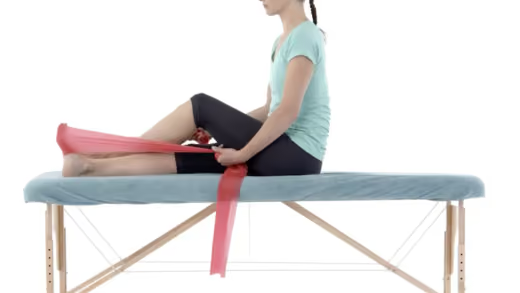
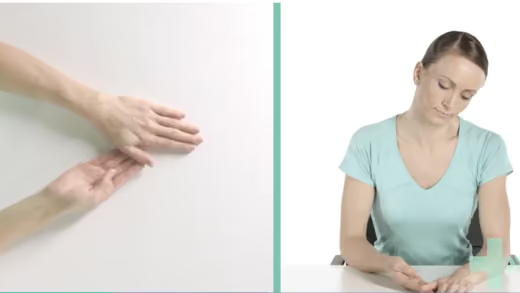
Sit upright in a chair. Place your affected arm on a table with your wrist hanging over the edge, palm facing in.

Step 2
Wrap the band around your hand, holding then ends taut but not stretched under your foot.

Step 3
Use your opposite hand to lift your wrist towards the ceiling, keeping your forearm in contact with the table.

Step 4
Let go of your affected hand and slowly lower your hand back towards the floor.
Radial deviation exercise is an effective way to improve upper arm strength and shoulder stability. Using a straight arm and bent elbow, this movement targets the muscles of the forearm and wrist. Follow an appropriate weight, number of sets and repetitions to maximize the benefit.
3. About the radial deviation
- Radial deviation is a movement that involves moving the thumb towards the radius
- It is generally done to increase strength in the forearm muscles
- When performing the exercise, keep your elbow close to your side and keep your wrists in the neutral position
- Move your thumb in a circular motion, tracking along the radius bone
- Aim to perform a minimum of 8-12 reps each session to achieve optimal results
4. List benefits of radial deviation
Here are some potential benefits of performing this exercise:
- Improves strength and coordination of the wrist and forearm muscles
- Increases range of motion in the wrist joint
- Reduces pain and discomfort in the wrist and forearm
- Improves grip strength and dexterity
- Enhances sports performance by increasing power and accuracy of the wrist and forearm muscles
5. FAQ on radial deviation
What is radial deviation?
Radial deviation is a type of movement of the wrist joint, in which the thumb moves away from the midline of the body. It is the opposite of ulnar deviation, which is the movement of the thumb towards the midline. Radial deviation is used in activities such as opening a door or turning a key.
What muscles are used in radial deviation?
The muscles used in radial deviation are the brachioradialis, extensor carpi radialis longus and brevis, and the extensor carpi ulnaris.
What is the proper form for radial deviation?
The proper form for radial deviation is a deviation of the thumb away from the plane of the palm. This is typically measured in degrees and can range from 0 to 90 degrees.
How often should I do radial deviation?
Radial deviation exercises should be done at least twice a week, but can be done more frequently depending on the severity of the condition. It is important to listen to your body and not overdo it, as too much exercise can cause further injury.
What are the common mistakes when doing radial deviation?
Common mistakes when doing radial deviation include not keeping the wrist in a neutral position, not keeping the elbow in line with the shoulder, and not keeping the shoulder blade down and back. Additionally, many people do not keep the thumb in line with the forearm and allow the thumb to move away from the forearm. Finally, some people do not use the correct range of motion when doing radial deviation.