Closing India's Physiotherapy Access Gap: Why Tier-2 and Tier-3 Cities Are the Next Growth Frontier
Resumo
- Published research found that only 37% of India’s rural population had inpatient care within 5 km, while just 8% could access outpatient care.
- Tier-2 and tier-3 cities give established clinics a path to serve patient demand beyond metro locations without opening a branch in every market.
- Hybrid physiotherapy combines remote care with in-person assessment or treatment when a patient’s condition requires it.
- Video consultations let clinicians conduct suitable assessments and follow-ups across distance.
- Activity-level adherence tracking shows whether patients complete prescribed exercises, while regional-language content helps patients understand and follow their programmes.
The documented gap in physiotherapy access
Published research found that only 37% of India’s rural population had access to inpatient care within 5 km of home. The same study found that just 8% of the rural population could access outpatient care within that distance. Geographic access therefore remains limited for rural patients before cost, appointment availability, or clinical suitability enter the calculation.
Physiotherapy often creates a greater access burden than a single hospital visit. A patient may need an initial assessment followed by regular supervised sessions and several weeks of home exercises. Each additional trip compounds the effects of travel time, transport cost, limited mobility, and missed work. A facility located within reach may still lack a physiotherapist or the capacity to support repeated rehabilitation visits.
The concentration of physiotherapists in metropolitan areas deepens that burden for patients in tier-2 and tier-3 cities. The 37% figure does not measure physiotherapist availability or provide a city-level workforce breakdown, so it should not serve as a direct estimate of rehabilitation coverage. It does establish the underlying constraint. Rural patients already struggle to reach general inpatient and outpatient care, while physiotherapy depends on repeated access to a more specialised workforce that smaller cities may not have locally.
Why this is a growth frontier, not just a policy gap
Clinic operators can view underserved cities as potential service areas because patients outside major metros already use remote consultations at scale. By 2024, the government’s eSanjeevani platform had supported more than 120 million consultations, primarily for rural and smaller urban populations. Such usage indicates that patients will engage with remote care when clinicians make it accessible.
Private telehealth expansion supports the same commercial reading. Platforms including Practo, 1mg, Apollo Telehealth, and Tata Health have expanded particularly across urban and semi-urban areas. Mobile connectivity and patient familiarity give clinics a base for serving smaller cities without waiting for local physiotherapy supply to match metro levels.
The available evidence does not isolate physiotherapy demand by city tier, so it cannot quantify the exact market for rehabilitation services. However, physiotherapy often requires repeated contact over several weeks. Remote follow-ups can reduce the distance and travel costs that make sustained care harder to access.
A hybrid model lets an established metro clinic or hospital network extend its existing clinical capacity rather than opening a branch in every target city. Clinicians can conduct suitable consultations and follow-ups by video, deliver home exercise programmes digitally, and direct patients to local in-person care when hands-on assessment or treatment is required. The clinic gains geographic reach while keeping fixed property and staffing commitments lower than a full branch rollout.
Clinic operators can test demand before making larger investments. A limited rollout can begin with follow-up care for patients in selected cities, then expand as referral volume and patient engagement become clearer. Remote delivery therefore provides a practical way to measure underserved demand and decide where a physical presence may eventually make sense.
What a hybrid delivery model actually requires
Hybrid physiotherapy combines in-person care where clinically necessary with three remote functions. Video consultations support assessment and follow-up. Activity-level adherence tracking shows whether patients complete prescribed exercises, while multi-language content helps patients understand what to do at home.
Each function covers a different weakness in remote delivery. A video call gives the clinician direct contact but cannot show what the patient does between appointments. Adherence data fills part of that information gap, while understandable exercise instructions help the patient perform the programme correctly.
Clinics need all three because research on telehealth adoption in India identifies limited connectivity, digital literacy gaps, and linguistic diversity as persistent barriers. The following sections examine how each component supports a workable hybrid model for tier-2 and tier-3 cities.
Video consultation for assessment and follow-up
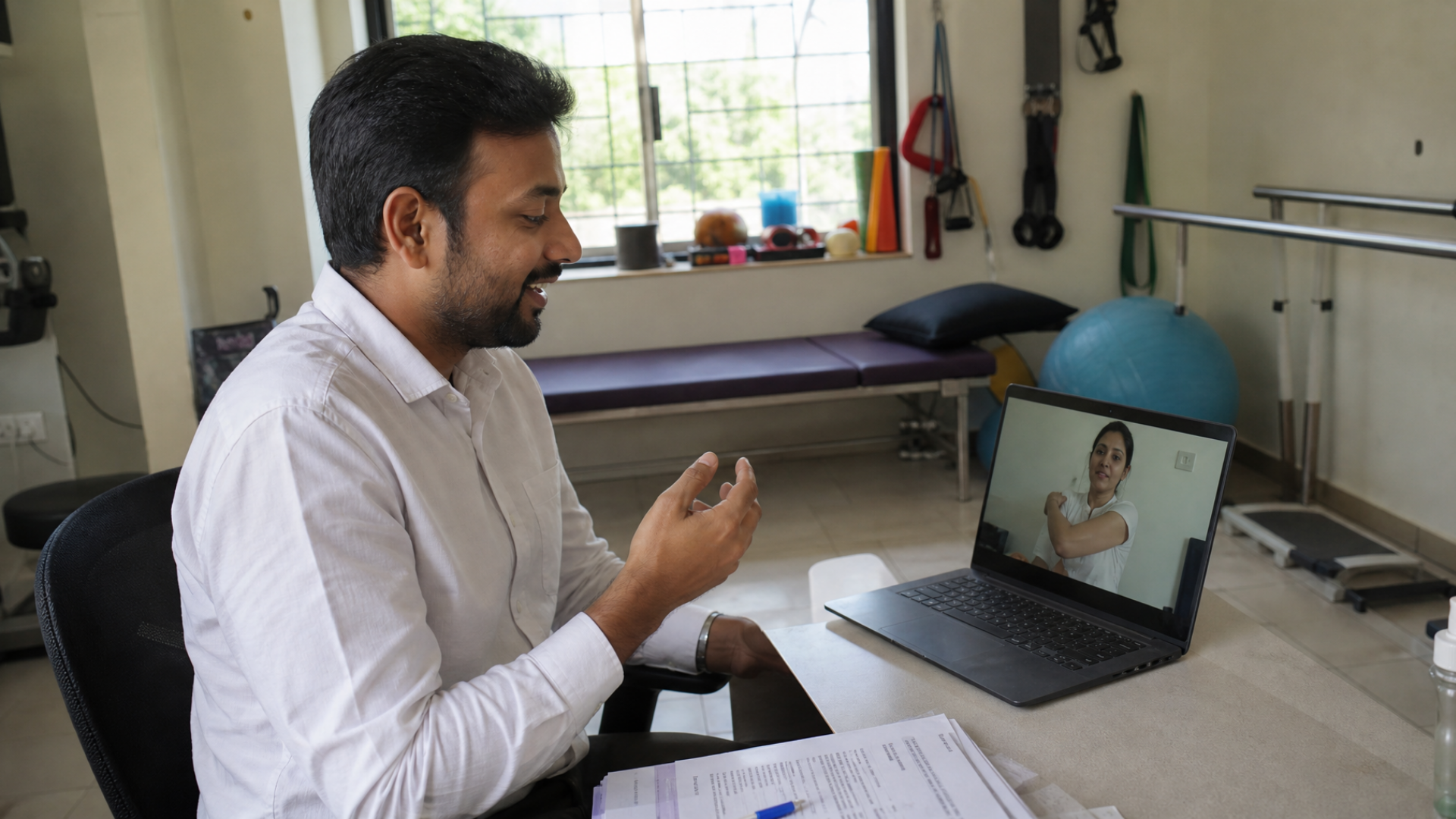
Video consultation lets a metro-based clinician assess selected patients in tier-2 and tier-3 cities without requiring immediate travel. During an initial appointment, the clinician can take a history, observe movement, review functional tasks, and identify symptoms that require local examination. Reliable video matters because physiotherapy assessment often depends on seeing how a patient moves.
Remote assessment has clear clinical limits. A screen cannot support palpation, hands-on testing, or certain neurological and orthopaedic examinations. Clinicians should arrange in-person assessment when symptoms indicate urgent evaluation, when video cannot provide enough evidence, or when treatment requires physical contact. Indian telehealth research describes hybrid care as a combination of virtual and in-person consultations.
Follow-up care often fits video particularly well because the clinician already knows the diagnosis and treatment plan. The patient can demonstrate exercises, describe pain or difficulty, and receive corrections without making a long trip. Physitrack provides telehealth alongside exercise-program delivery and patient monitoring, which allows the consultation to connect directly with the patient’s work between appointments. A clinic can therefore use video for suitable assessments and routine reviews while directing patients to local in-person care when the clinical situation requires it.
Adherence tracking that verifies real engagement
Activity-level adherence data gives clinicians stronger evidence of participation than a login record. A login confirms that a patient opened an app, but it does not show whether the patient attempted an assigned exercise. Activity tracking records engagement with individual exercises and can pair completion data with patient-reported progress or discomfort.
Remote physiotherapy makes that distinction more important because clinicians lose many signals available during an in-person appointment. A clinician cannot watch the patient arrive with limited mobility or ask an immediate follow-up after observing an exercise. Detailed adherence data helps the clinician identify missed sessions, recurring difficulty, or symptom changes before the next video consultation.
Useful adherence data should also support clinical decisions. For example, repeated non-completion may indicate that the programme feels too difficult, while reported discomfort may call for a prompt review. The clinician can then contact the patient, adjust the programme, or recommend an in-person assessment when appropriate.
Our Physitrack platform tracks activity within assigned home exercise programmes rather than treating app access as proof of participation. That level of monitoring gives metro-based clinicians a clearer view of patients completing rehabilitation in tier-2 and tier-3 cities, where routine face-to-face observation may not be available.
Multi-language exercise content as an adoption requirement
Language directly affects adherence because patients must understand each movement, its frequency, and its safety instructions before they can follow a home exercise programme correctly. Clear video and simple navigation cannot compensate for instructions that a patient cannot interpret.
Research on telehealth adoption in India identifies linguistic diversity as a barrier in underserved states such as Bihar and Jharkhand. A clinic entering these markets should match patient-facing content to local language needs before rollout. Useful translation covers spoken and written exercise guidance, rather than interface menus alone.
For example, Physitrack includes Hindi-language exercise content within its multilingual library. A clinician can prescribe the programme, confirm the patient understands it during consultation, and monitor subsequent activity. That combination reduces the risk that a patient appears disengaged when the actual barrier is unclear instruction.
Evaluating whether and how to expand into underserved cities
Choose a platform by testing how it supports a defined care pathway under local conditions. Research identifies connectivity, digital literacy, and linguistic diversity as persistent barriers to telehealth adoption, so a successful metro workflow may need adjustment in smaller cities.
Video consultation capability
Check whether clinicians can complete suitable assessments and follow-ups on unreliable connections. The platform should also support clear escalation to local in-person care when a physical examination, hands-on treatment, or urgent review becomes necessary.
Evidence of patient participation
Ask what the platform records after a clinician assigns a home exercise programme. Activity completion, reported discomfort, and progress data provide more useful evidence than a login or opened link. Clinicians need enough detail to identify missed exercises and adjust care without waiting for the next appointment.
Patient-facing language support
Review the actual exercise videos and instructions in the languages your target patients use. A translated interface cannot compensate for exercise guidance that remains difficult to understand. Physitrack offers Hindi exercise content alongside telehealth and activity-based adherence tracking, but buyers should test these capabilities with patients before wider deployment.
A staged rollout
Begin with remote follow-up for existing patients whose condition and treatment plan are already known. A limited pilot lets you measure exercise completion and follow-up attendance while testing referral arrangements with local clinicians. Expand into remote initial assessment only after clinicians have agreed on eligibility, safety, and escalation rules. Hospital networks should also confirm how the platform fits existing patient records, consent procedures, and clinical oversight before adding cities.
The takeaway for clinic operators
India’s uneven physiotherapy coverage creates an operating opportunity that clinics can address now. A metro-based or multi-location clinic can extend continuity of care into underserved cities without funding a full branch before it validates local demand.
Early-moving clinics can build relationships with patients whose needs local physiotherapy capacity does not fully meet. For the wider health system, that expansion distributes clinician capacity more evenly and gives patients sustained access to rehabilitation. For clinic operators, it provides a measured path into new markets while keeping physical expansion tied to demonstrated patient volume.
Perguntas frequentes
-
Can telehealth replace in-person physiotherapy in India? Telehealth supports consultations, progress reviews, and supervised home exercise when a clinician can assess the patient safely by video. Physitrack combines video consultations with exercise delivery and remote progress data. Patients still need in-person assessment when their condition requires physical examination, hands-on treatment, or urgent care.
-
Which rules govern remote consultations in India? The Ministry of Health and Family Welfare introduced the Telemedicine Practice Guidelines in March 2020 as a formal structure for remote healthcare consultations. Clinics using Physitrack remain responsible for applying relevant professional, consent, privacy, and clinical requirements. A defined governance process helps clinicians decide which patients can receive remote care safely.
-
How does adherence tracking differ from app login data? Login data shows that a patient opened an app, while activity-level tracking records completed exercises and reported progress. Physitrack captures patient activity through PhysiApp rather than treating access alone as adherence. Clinicians gain a more useful basis for follow-up decisions when patients live far from the clinic.