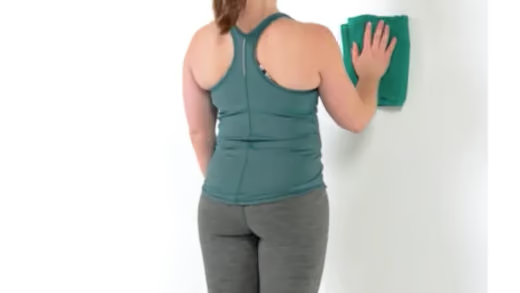
Step-by step guide to the wall clock exercise
Maximize effectiveness: Tips for patients and practitioners
1. Step-by-step on how to do the wall clock exercise.
2. How to perform the wall clock. Follow these instructions.

Step 1
Start by placing post it notes labelled 1 to 12 in a circle on the wall to mimic a large clock face. Place another post it note, marked with an X, at eye level, in the centre of the clock. Begin by standing with feet hip width apart in front of the wall, centred with the clock.

Step 2
Keep your head still throughout the exercise and move only your eyes. Focus on the X and then move your eyes quickly to the first post it note and back to the X. Then repeat by shifting your gaze quickly to the next post it note and back to X, working in a clockwise direction. Work around the clock face, looking at each post it note in turn. After one round repeat the whole exercise again, working in a counter clockwise direction.
3. About the wall clock exercise.
- Targets the rotator cuff and other smaller muscles in the shoulder joint
- Can be done anywhere a wall is available
- Proper form is essential
4. Benefits of the wall clock exercise.
Here are some potential benefits of performing this exercise:
- Improved physical endurance
- Improved concentration
- Improved strength and balance
- Improved coordination and coordination skills
5. FAQ on the wall clock exercise.
What is the purpose of wall clock exercise?
Wall clock exercises are designed to stimulate the vestibular system, which plays a crucial role in balance and spatial orientation. By incorporating head movements in different planes and directions while focusing on a fixed point on the wall, these exercises help improve the brain's ability to process sensory information and enhance overall balance.
Who can benefit from wall clock exercises?
Wall clock exercises are often recommended for individuals undergoing vestibular rehabilitation, especially those who experience balance issues, dizziness, or vertigo. They can be beneficial for people recovering from inner ear disorders, head injuries, or other conditions affecting the vestibular system.
Are there any precautions or considerations for wall clock exercises?
It's important to start wall clock exercises gradually and consult with a healthcare professional or physical therapist, especially if you have a history of severe dizziness or balance problems. Perform the exercises in a safe environment, and discontinue if you experience excessive discomfort or worsening symptoms. Progress the intensity and duration of the exercises under the guidance of a healthcare professional.