Paediatric Physiotherapy for Cerebral Palsy: Home Exercise and Remote Care
TL;DR
- A structured home exercise programme extends a paediatric physiotherapist’s plan between appointments. Remote care supports rather than replaces in-person assessment and treatment.
- Home programmes commonly target gross motor skills, gait and mobility, and muscle tone through activities selected for the child’s needs.
- Parents and carers reinforce the prescribed technique, record completion, and watch for pain, unusual fatigue, increased resistance, skin problems, or loss of ability. They should pause and contact the physiotherapist when concerns arise.
- Adherence tracking shows clinicians which activities the child completes and which they report as difficult. Telehealth check-ins let clinicians observe movement and adjust repetitions, sets, or difficulty. Physitrack supports these tasks through video-supported exercise programmes, adherence tracking, and remote consultations.
Why home practice matters more for children with cerebral palsy
Children with cerebral palsy often need frequent, repeated practice to develop and retain functional motor skills. A clinic appointment may introduce a movement such as moving from sitting to standing, but practice during everyday routines gives the child more opportunities to use it. Short, regular sessions can therefore support the goals set by the child’s physiotherapist.
Appointments alone rarely provide enough time for this level of repetition. NHS caseloads, private treatment costs, and limited clinician availability can restrict appointment frequency. Rural families may also spend considerable time travelling to a clinic, while transport accessibility, school, work, and caring responsibilities can make frequent visits impractical.
A home exercise programme extends the clinician-led plan of care between appointments. The physiotherapist selects exercises for the child’s current abilities, explains the intended technique and dosage, and reviews how the child responds. Parents and carers then support the agreed activities and record difficulties rather than choosing new exercises or increasing the challenge independently.
Home practice does not replace skilled in-person assessment and treatment. A physiotherapist still needs to assess movement, set suitable goals, and decide when an exercise should change. Remote reviews can support that relationship by giving the physiotherapist a view of progress between visits, while scheduled appointments allow closer assessment when the child’s needs change.
Building gross motor function at home: sitting, transitions and standing
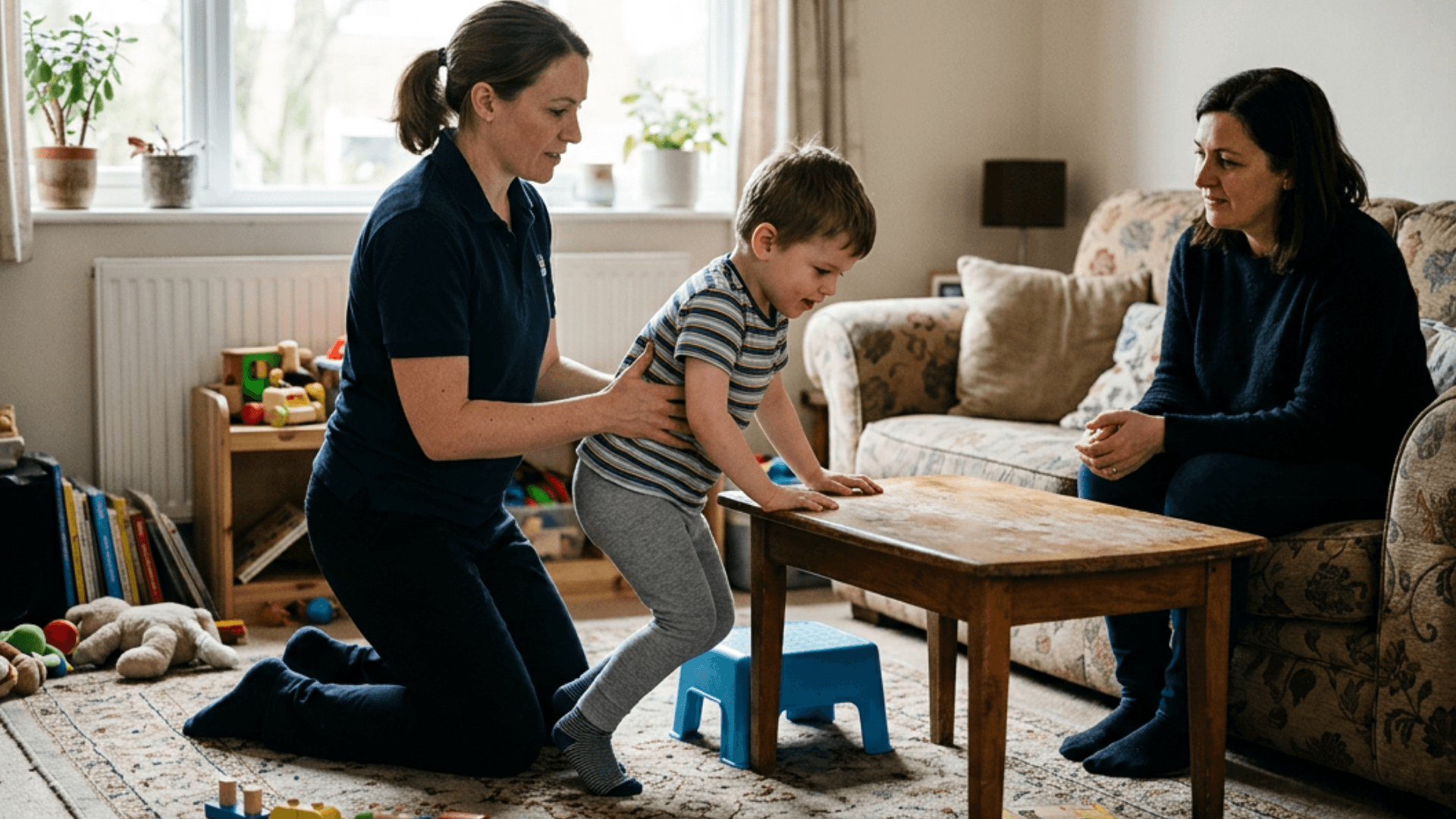
A gross motor home programme turns functional goals into short activities that fit the child’s routine. A physiotherapist might prescribe supported sitting during play, repeated transitions between sitting and standing, or brief periods of supported standing. The physiotherapist sets the starting position, amount of assistance, and suitable dose according to the child’s current abilities.
Carers reinforce the prescribed movement rather than teaching a new technique themselves. During sitting practice, a carer may place toys within reach while providing the recommended support at the pelvis or trunk. For transitions, the carer follows the demonstrated hand placement and allows enough time for the child to initiate the movement. Standing practice should use the specified furniture, equipment, or orthoses and take place on a stable surface.
Clear instructions help carers provide consistent support without doing too much of the movement for the child. A physiotherapist can use a Physitrack home exercise programme builder to record the exercise dose, required assistance, and progression criteria. Video demonstrations give carers a reference for body position and pacing after the appointment. Written notes should explain when to reduce support and when to keep the activity unchanged until review.
Fatigue often appears as deteriorating movement quality rather than a simple statement that the child feels tired. A child may need more assistance than usual, lose head or trunk control, drag a limb, or become unusually irritable during a familiar task. Carers should stop the activity if those signs persist after a short rest.
Pain and regression also require contact with the treating physiotherapist. Pain may appear through crying, grimacing, guarding, or reluctance to use one side. Regression includes losing a previously reliable skill or suddenly needing much more support for sitting, transfers, or standing. Carers should record what happened and avoid increasing repetitions or assistance to push through the problem.
Supporting gait and mobility: foot drop and asymmetric patterns
Home gait practice should repeat the walking strategy chosen by the child’s physiotherapist. Foot drop describes difficulty lifting the front of the foot during the swing phase, which can lead to toe dragging or compensatory movements. An asymmetric pattern may involve taking unequal steps, placing more weight through one side, or holding the trunk differently. Each pattern has several possible causes, so carers should reinforce prescribed drills rather than try to correct the gait independently.
“Good enough” practice means that the child completes a short, safe bout using the agreed cue and level of support. A carer might prompt the child to clear the foot, place the heel, or shift weight as demonstrated by the physiotherapist. Suitable practice can fit into supervised walking indoors or another familiar activity. Carers should avoid giving several corrections at once because competing instructions can disrupt balance and make the child less confident.
Orthoses and positioning routines require the same consistency as walking drills. Carers should follow the prescribed wearing schedule, check that straps and footwear sit correctly, and inspect the skin after use. New rubbing, persistent redness, pain, repeated trips, or a clear deterioration in walking should prompt contact with the physiotherapist. Carers should not alter an orthosis or increase walking distance to push through a problem.
Gait often needs closer remote observation than a static exercise because balance and joint position change with every step. During a video check-in, the physiotherapist can watch the child walk towards, away from, and across the camera. The clinician can then adjust the cue, support level, distance, or drill and decide whether an in-person assessment is needed.
Physitrack lets clinicians include video demonstrations of gait-specific drills in a home exercise programme. Carers can review the intended setup and form before practice, while follow-up check-ins help the physiotherapist identify compensatory movements that a standard exercise video cannot assess.
Managing muscle tone: stretching and positioning for spasticity
Daily stretching and planned positioning can help maintain joint range and make movement or personal care more comfortable for a child with spasticity. The physiotherapist should select each stretch according to the child’s movement, muscle tone, joint range, and any orthoses or other equipment they use. Carers then repeat the prescribed routine consistently between reviews.
Carers should follow the specified range, force, and duration for every stretch. They should move the limb slowly until reaching the point demonstrated by the physiotherapist, then hold it without bouncing or forcing the joint further. Muscle resistance may change with discomfort, illness, or heightened muscle tone, so a range that was manageable yesterday may not be appropriate today.
Positioning routines support comfort and joint alignment during activities such as sitting, lying, and supported standing. The physiotherapist may recommend cushions, sleep positioning equipment, standing frames, or splints. Carers should use equipment as instructed and check that straps or supports do not create pressure, rubbing, or changes in skin colour.
If the child experiences increased pain, stronger resistance than usual, or new skin problems, carers should pause the routine and contact the treating physiotherapist. Carers should also report a persistent reduction in range or difficulty applying an orthosis that previously fitted. Pushing through resistance can irritate tissues and may make the routine harder for the child to tolerate.
A predictable routine often makes tone management easier to maintain. Carers can link stretches to dressing, bedtime, or another regular activity, while offering the child simple choices about order or position. A brief record of completed stretches, discomfort, resistance, and skin changes gives the physiotherapist useful information for adjusting the programme.
Keeping a remote or hybrid plan of care safe
A safe remote plan starts with a clear baseline and specific instructions. Before home practice begins, the physiotherapist records the child’s current ability and defines the expected level of assistance. The instructions for each prescribed activity should include its frequency, repetitions, rest periods, and stopping points. Parents and carers then know what normal effort looks like and when to pause.
Adherence data helps the physiotherapist interpret changes between appointments. Completion records show how much practice the child attempted, while feedback on difficulty and progress shows how well the child tolerated it. For example, limited progress after several weeks may reflect missed sessions rather than an unsuitable exercise. A complete record does not prove that the child used the correct technique, but it tells the clinician what to examine during the next check-in.
Physitrack lets clinicians assign video-supported home exercise programmes and review adherence and reported progress remotely. The clinician can compare planned activity with recorded completion instead of relying on recall at the next appointment. Unexpected difficulty, falling completion, pain reports, or loss of function can prompt earlier contact.
Telehealth check-ins let the physiotherapist assess movement quality before small errors become established habits. The clinician can watch how the child sits, transfers, stands, or walks and can ask the carer to change the camera position when needed. During stretching or positioning activities, the physiotherapist can also check hand placement, range, and the child’s response.
The physiotherapist can then adjust repetitions, sets, or difficulty according to what the child demonstrates. Changing one parameter at a time makes the child’s response easier to interpret. The clinician may simplify a task, add rest, alter the support provided by the carer, or arrange an in-person review when remote observation cannot answer the clinical question.
Remote oversight works best within a hybrid plan that keeps clear escalation routes. If new pain, regression, increased asymmetry, unusual resistance, or skin problems occur, carers should pause home practice and contact the treating physiotherapist. An in-person appointment remains appropriate when the clinician needs hands-on assessment, equipment review, or a fuller examination.
Getting started with a home and remote care plan
Physiotherapists should begin with a small set of exercises tied to the child’s current goals. Specify the technique, frequency, repetitions, acceptable effort, and signs that require the family to pause and contact the physiotherapist. Schedule remote reviews around the child’s needs, with in-person reassessment when hands-on examination or treatment is required.
Parents and carers should follow the prescribed programme rather than adding or progressing exercises independently. Record completed sessions, pain, unusual fatigue, increased stiffness, or changes in movement. Share those observations during remote check-ins so the physiotherapist can adjust the programme safely.
Structured home practice gives children regular opportunities to work on movement skills, while remote oversight helps the physiotherapist check technique and respond to problems. Physitrack supports this approach with video demonstrations, programme delivery, adherence tracking, and telehealth. Explore Physitrack’s home exercise programme builder to see how you can manage the workflow between appointments.
Frequently asked questions
How often should a child complete home exercises?
Exercise frequency depends on the child’s goals, abilities, fatigue, and wider treatment plan. Physitrack lets the physiotherapist prescribe a specific schedule and review recorded completion. Parents and carers should follow that schedule rather than adding repetitions or sessions without clinical advice.
What should I do if my child refuses or resists an exercise?
Refusal may reflect tiredness, discomfort, difficulty, fear, or loss of interest. Parents and carers can record the response in PhysiApp, Physitrack’s patient app, and discuss repeated resistance with the physiotherapist. A clinician can then adjust the activity, dosage, instructions, or timing without turning practice into a struggle.
How can a physiotherapist measure progress remotely?
Remote measurement combines completion records, symptom reports, carer observations, video appointments, and agreed functional measures. Physitrack gives clinicians access to adherence and reported progress between appointments. Clinicians can use those records to decide whether to continue or progress the programme, or pause it for reassessment.
Does remote care replace in-person paediatric physiotherapy?
Remote care extends a clinician-led plan between assessments rather than replacing hands-on physiotherapy. Physitrack supports exercise delivery, monitoring, and video check-ins while the treating physiotherapist retains responsibility for assessment and progression. In-person appointments remain important when the child needs physical examination, equipment review, hands-on support, or closer assessment of changing symptoms.