Step-by step guide to the lateral rotation exercise
Maximize effectiveness: Tips for patients and practitioners
1. Step-by-step video on how to do the lateral rotation exercise
How to perform the Lateral Rotation
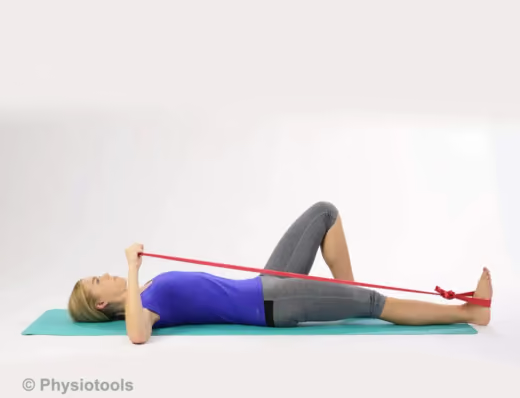
Step 1
Lie on your back with knees bent and with your arm out to your side with elbow bent. Hold the end of an exercise band that is placed around your foot.
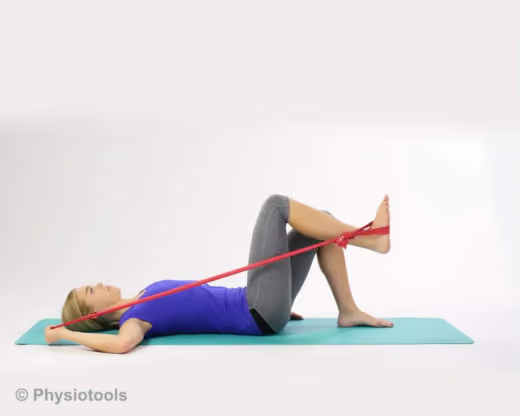
Step 2
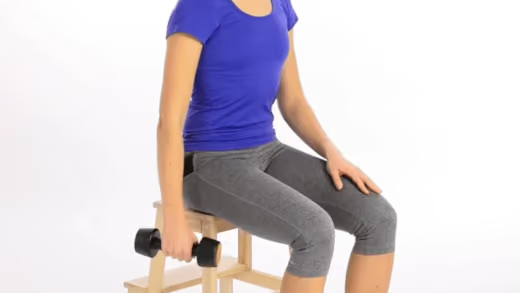
Bend your knee towards your chest and rotate your arm outward.
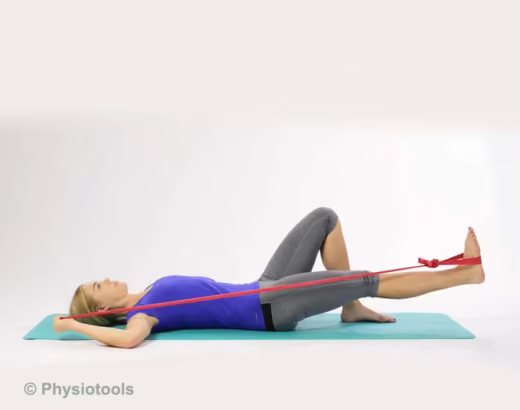
Step 3
Extend your knee to increase resistance, and then slowly and in a controlled manner lower your forearm towards the floor against the resistance
3. About the lateral rotation exercise
- Lateral rotation is an exercise primarily used to increase the strength and flexibility of the hips and back muscles.
- It can help improve posture, mobility, and balance.
- It should be done with light weights or no weight at all to minimize risk of injury.
4. Benefits of the lateral rotation exercise
Here are some potential benefits of performing this exercise:
- Strengthens the muscles of the lower back, abdominals, and hips.
- Promotes better posture.
- Improves functional strength and flexibility.
- Enhances range of motion in the joints of the hips and lower spine.
5. FAQ on the lateral rotation exercise
What muscles are used in lateral rotation?
The muscles used in lateral rotation are the external oblique, internal oblique, and quadratus lumborum.
How often should I perform lateral rotation?
The frequency of lateral rotation exercises will depend on your individual needs. Generally, it is recommended to perform lateral rotation exercises at least 2-3 times per week. However, if you have an injury or specific need, consult with your healthcare provider to determine the best frequency for your individual situation.
What is the difference between lateral rotation and internal rotation?
Lateral rotation is the movement of a joint or body part away from the midline of the body, while internal rotation is the movement of a joint or body part towards the midline of the body. For example, when you turn your arm outwards, away from your body, you are performing lateral rotation. When you turn your arm inwards, towards your body, you are performing internal rotation.
What are the risks associated with lateral rotation?
The risks associated with lateral rotation include potential nerve damage, muscle strain, joint instability, and increased risk of injury. Additionally, if the rotation is done too quickly or with too much force, it can cause ligament damage or even fractures. It is important to ensure that lateral rotations are done slowly and with proper form to reduce the risk of injury.