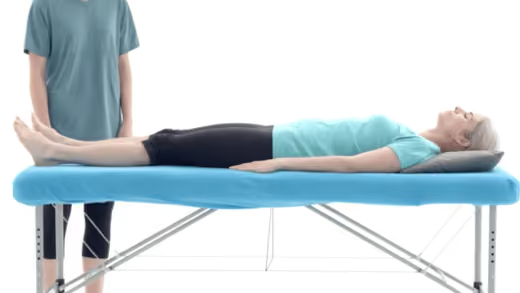
Step-by step guide to the forearm pronation exercise
Maximize effectiveness: Tips for patients and practitioners
1. Step-by-step video on how to do the forearm pronation
2. How to perform the forearm pronation? Follow these instructions:
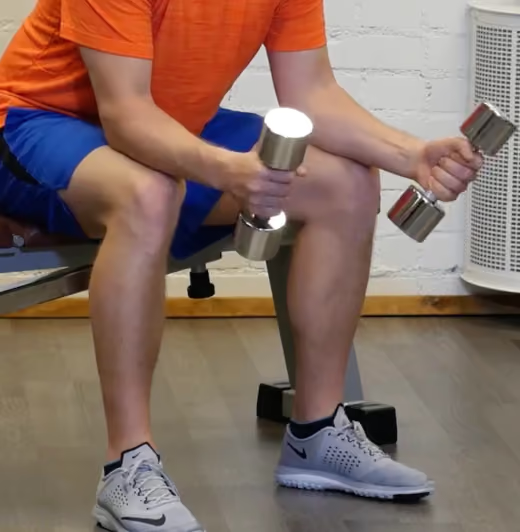
Step 1
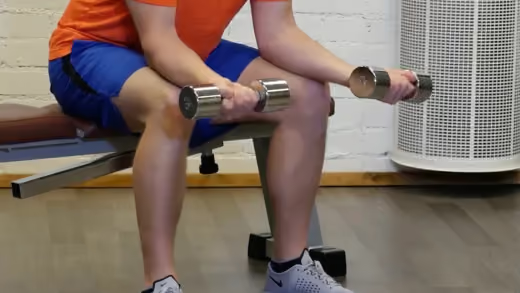
Sit on a bench with your forearms supported on your thighs and wrists hanging over your knees
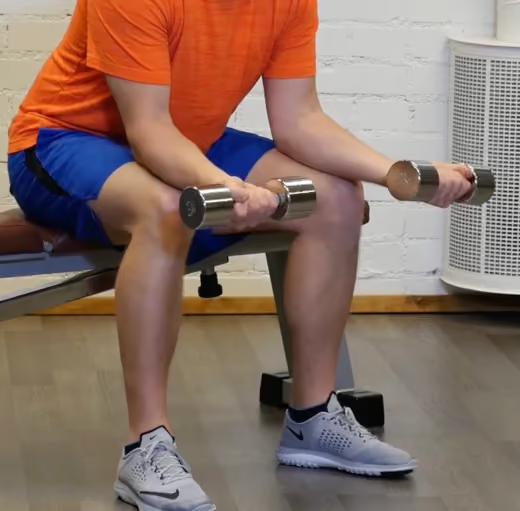
Step 2
Hold dumbbells in both hands with your palms facing upwards and wrists at neutral position (straight line from elbow to knuckles).
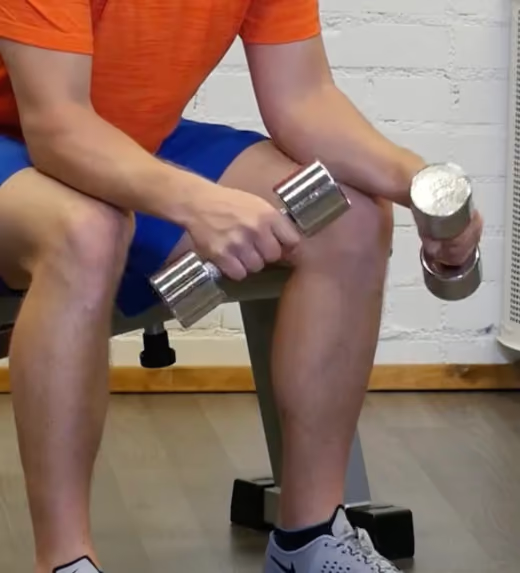
Step 3
Start rotating your palms to face alternately downwards and upwards.
Forearm pronation exercise can help to strengthen and stretch your arm muscles for better overall performance and balance. This type of exercise, when done correctly, can increase your hand’s range of motion and decrease pain in your wrist joint.
3. About the forearm pronation
- Focuses on strengthening and improving the activation of muscles in the forearm and shoulder
- Improves forearm strength and mobility of the wrist
- Reduces risk of injury due to the improved tissue quality in the area
- Increases range of motion which can improve activity and performance
4. List benefits of forearm pronation
Here are some potential benefits of performing this exercise:
- Improved mobility in the wrists, elbows and shoulders.
- Better grip strength.
- Increased flexibilty in the forearm muscles.
- Enhanced coordination between the upper and lower arm.
- Greater range of motion, aiding in other exercises and everyday activities.
5. FAQ on forearm pronation
What is the correct form for forearm pronation/supination?
The correct form for forearm pronation/supination is to start with your elbow bent at 90 degrees and your forearm in a neutral position. Then, rotate your forearm so that your palm is facing down (pronation) or up (supination).
How often should I do forearm pronation/supination?
It is recommended to do forearm pronation/supination exercises 2-3 times a week. It is important to allow your muscles to rest in between workouts to prevent overuse injuries.
What muscles are used during forearm pronation/supination?
The muscles used during forearm pronation/supination are the pronator teres, pronator quadratus, and supinator muscles.
What are the potential risks of doing forearm pronation/supination?
The potential risks of doing forearm pronation/supination exercises include: 1. Strains and tears in the muscles and tendons of the forearm. 2. Increased risk of overuse injuries such as tendonitis or bursitis. 3. Risk of joint instability due to weakened ligaments and muscles. 4. Increased risk of wrist and elbow pain due to improper form or technique. 5. Risk of nerve damage due to excessive pressure on the nerves in the forearm.
How can I vary my forearm pronation/supination exercises?
There are several ways to vary your forearm pronation/supination exercises. You can use different types of equipment such as resistance bands, dumbbells, or kettlebells. You can also vary the speed of the exercise, the number of repetitions, and the angle of your wrist. Additionally, you can add different types of movements such as rotations, circles, or pulses. Finally, you can perform the exercise in different positions such as standing, sitting, or lying down.