Physitrack vs MedBridge vs Limber Health: The Enterprise PT Platform Comparison (2026)
Introduction
Enterprise physical therapy platform selection can affect clinical workflows, patient engagement, remote care, reporting, and integration across an organization. Buyers should compare each platform against their clinical, technical, compliance, and implementation requirements.
Physitrack, MedBridge, and Limber Health approach digital physical therapy from different starting points. Physitrack is an all-in-one, AI-powered electronic medical record and practice management platform for physical therapy practices, with additional capabilities for enterprise patient engagement and remote care. MedBridge combines patient care tools with continuing education, while Limber Health focuses on digital musculoskeletal care, RTM, outcomes collection, and MIPS reporting.
This comparison evaluates all three across home exercise programs, RTM capabilities, documented EHR integration, patient engagement, and enterprise scalability. The analysis draws from public documentation, competitor marketing claims, and platform capabilities as documented on official websites.
Disclosure: This comparison is published by Physitrack. All competitor data is sourced from publicly available documentation and marketing materials.
Platform snapshot
Physitrack
Physitrack is our all-in-one, AI-powered electronic medical record and practice management platform for physical therapy practices. We combine scheduling, patient intake, charting, an AI scribe, administrative automation, home exercise programs, patient engagement, and remote care in one platform. Physitrack serves more than 110,000 clinicians across 174 countries and includes a library of more than 18,000 exercise videos.
MedBridge
MedBridge positions itself as the clinician education and patient care platform for US healthcare organizations. The platform features 8,000+ exercises with 100M+ programs assigned across its 15-year market presence. MedBridge combines continuing education with HEP and RTM capabilities. Its public materials describe tiered seat options and feature customer examples from organizations including ATI Physical Therapy, CORA Physical Therapy, Pivot Physical Therapy, and Athletico.
Limber Health
Limber Health operates as a digital MSK platform targeting US rehab therapy clinics, featuring 7,000+ professionally produced exercise videos. Limber Health combines RTM and HEP with outcomes collection and MIPS/QCDR reporting. The company is an APTA Digital Transparency pledge signatory. Its public provider materials focus on US rehabilitation therapy workflows.
Quick comparison table
1. Home exercise program builder
Physitrack
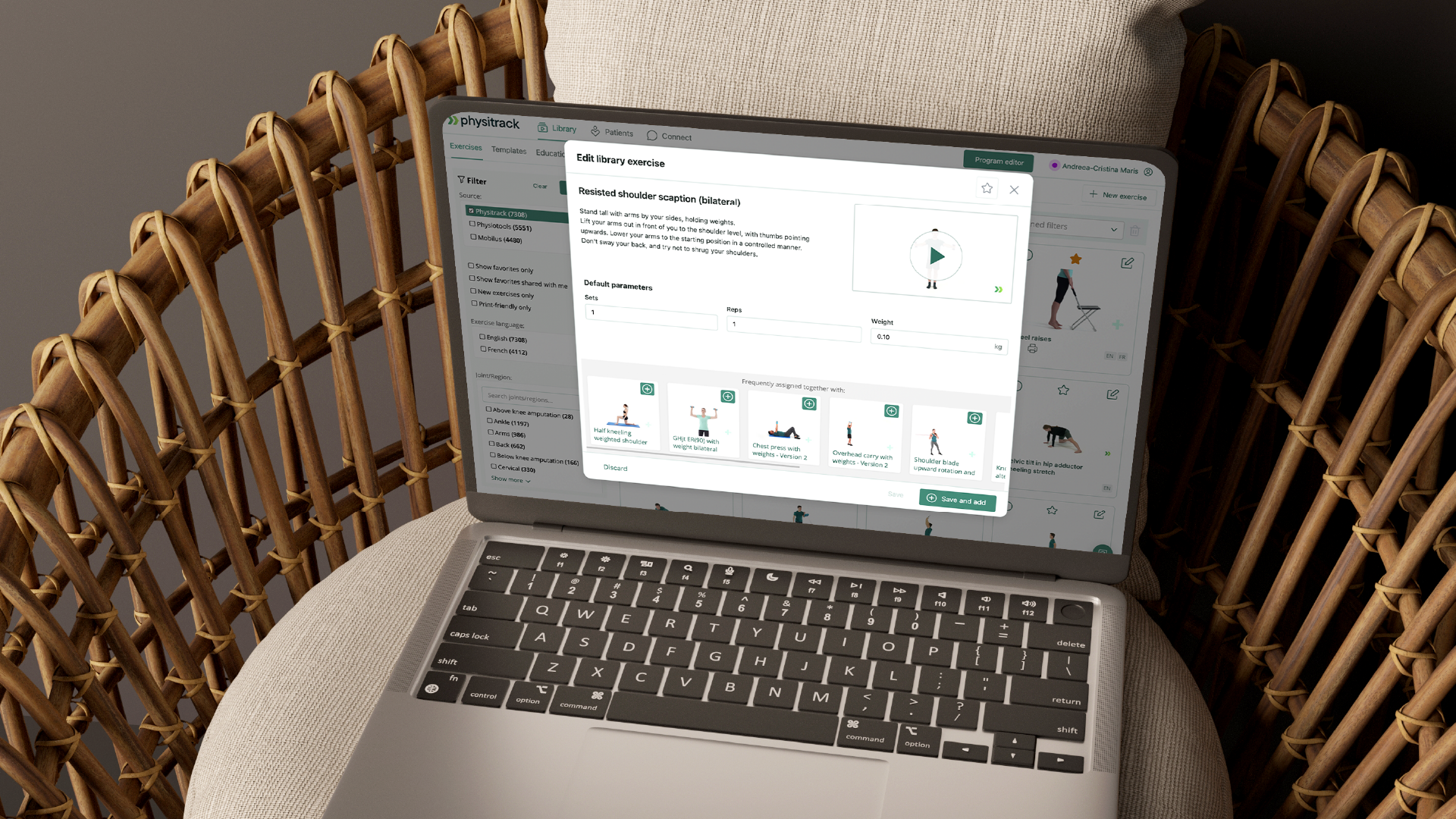
We provide more than 18,000 exercise videos, with the library available in 14 languages. AI Exercise Search helps clinicians find relevant exercises more efficiently while keeping exercise selection and clinical decisions under clinician control. The included library and unlimited prescription model can support organizations with high HEP volumes.
Physitrack supports physical therapy and other rehabilitation disciplines, including occupational therapy, speech and language therapy, chiropractic, and sports medicine. Through PhysiApp, patients can receive programs while clinicians track adherence, progress, and reported discomfort.
MedBridge
MedBridge offers 8,000+ exercises through a drag-and-drop builder with suggested exercise functionality. MedBridge provides shareable templates and copy-and-paste EMR documentation. Its patient education library includes more than 1,000 video and print resources beyond exercise prescription. MedBridge publicly presents seat-based options for individuals, teams, and larger organizations. Buyers should confirm the HEP usage terms that apply to their proposed plan.
The MedBridge GO app uses streaks and push notifications to encourage patient participation. MedBridge reports that more than 100 million programs have been assigned during its 15 years in the market. Its public materials name ATI Physical Therapy and CORA Physical Therapy as customers.
Limber Health
Limber Health provides 7,000+ professionally produced exercise videos delivered through a patient mobile app. Limber Health combines HEP functionality with RTM and outcomes collection for rehabilitation clinics that want those tools in one platform. The reviewed provider materials do not prominently document custom exercise uploads or multilingual deployment. Buyers that require either capability should confirm current availability with Limber Health.
HEP differentiators table
HEP assessment: Based on the criteria in this comparison, Physitrack has the largest documented library and offers unlimited prescription and multilingual support.
2. Remote therapeutic monitoring
Physitrack
We provide RTM alongside HEP, telehealth, and PROMs. Current RTM capabilities include enrollment status, automatic logging of qualifying activity, clinician time tracking, manual entries, threshold alerts, a review step that assembles evidence for billing documentation, and exportable practice reporting. Clinicians remain responsible for reviewing the evidence and confirming billing decisions. Our guide explains considerations for RTM in large organizations.
MedBridge
MedBridge offers RTM alongside its HEP capabilities and publishes resources about implementation and billing. Organizations should confirm the current module structure, commercial terms, and workflow details directly with MedBridge.
Limber Health
RTM is a prominent part of Limber Health's public positioning. Limber Health presents RTM as a central part of its provider offering. Its CMS-approved Qualified Clinical Data Registry supports MIPS reporting.
RTM differentiators table
RTM assessment: Physitrack connects RTM with HEP, PROMs, telehealth, and other patient-engagement features. Limber Health is a relevant option when QCDR and MIPS reporting are central requirements.
3. EHR and Epic integration
Physitrack
Physitrack offers an Epic integration for enterprise deployments. It connects home exercise programs and patient engagement with Epic workflows while supporting enterprise deployment requirements. Our EHR integration guide explains the integration in more detail.
MedBridge
MedBridge publicly documents a direct Epic integration and provides training and implementation information in its Epic integration overview. Buyers should confirm any additional integrations, implementation requirements, and international availability directly with MedBridge.
Limber Health
Limber Health does not prominently feature Epic integration on provider-facing pages. The reviewed provider materials do not prominently document Epic integration or international EHR support. That absence should not be read as proof that no integrations exist, so buyers should ask Limber Health to document the interfaces available for their environment.
EHR Differentiators Table
EHR integration assessment: Physitrack and MedBridge both document Epic integrations. Physitrack also reports use across 174 countries, but buyers should evaluate each integration against their Epic configuration, implementation requirements, and deployment markets.
4. Patient engagement and mobile apps
Physitrack — PhysiApp
Through PhysiApp, we connect exercise delivery with messaging, adherence tracking, patient-reported progress, telehealth, and remote care. Our multilingual support can help organizations serving diverse patient populations. Physitrack also offers sensor-free motion capture for movement tracking.
We support PROMs, adherence tracking, and outcome monitoring so clinicians can review patient progress between visits. Organizations should confirm the support model and service levels included in their proposed agreement.
MedBridge — Medbridge GO
MedBridge GO includes streaks, push notifications, and phased digital programs intended to encourage patient participation. The app includes patient reminders, pain/difficulty feedback loops, and patient-provider messaging between visits. MedBridge publishes customer success stories about patient engagement and retention. Buyers should review the methodology and organizational context before applying those results to their own setting.
The Digital Health Academy provides clinician onboarding and professional-development resources. Organizations that prioritize continuing education can include those resources in their evaluation. The reviewed materials do not prominently document telehealth, motion capture, or multilingual capabilities in Medbridge GO.
Limber Health
Limber's patient mobile app focuses on HEP delivery and RTM engagement with built-in outcomes collection and PROs. The app is positioned for US rehabilitation clinic workflows. The reviewed provider materials do not prominently document telehealth integration, motion capture, or multilingual support.
Patient Engagement Differentiators Table
Patient engagement assessment: Physitrack documents telehealth, motion capture, PROMs, and multilingual support. MedBridge emphasizes streaks, push notifications, and continuing education.
5. Enterprise scalability and multi-site support
Physitrack
Physitrack serves more than 110,000 clinicians across 174 countries. We support multi-clinic standardization, shared protocols, outcome management, EHR integrations, and enterprise customer success for organizations coordinating care across locations.
Organizations should evaluate security, privacy, data hosting, interoperability, governance, and implementation requirements as part of procurement. Physitrack can provide the documentation applicable to the proposed deployment.
Physitrack also supports occupational health and multi-discipline rehabilitation use cases. Enterprise buyers should confirm the support structure, onboarding plan, and contractual service levels offered for their deployment.
MedBridge
MedBridge reports 15 years in the US market and names ATI Physical Therapy, CORA Physical Therapy, Pivot Physical Therapy, and Athletico in its public customer materials. The Large Organizations tier (50+ seats) offers custom pricing for enterprise deployments.
MedBridge's reviewed materials focus primarily on US organizations. Its continuing education and compliance training can support clinician development, while buyers planning international deployment should confirm regional availability, language support, and data requirements.
Limber Health
Limber Health's QCDR capabilities support MIPS reporting for US providers. Buyers should confirm whether the available reporting and deployment model meet their health system's scale and governance requirements.
International deployment and detailed enterprise support terms are not prominent in the reviewed materials. Buyers should request current documentation for regional availability, security, implementation support, and service levels.
Enterprise scalability differentiators table
Enterprise reach assessment: Physitrack reports the broadest geographic reach in this comparison and documents multilingual patient engagement, remote care, and multi-site standardization.
6. Pricing and total cost of ownership
Pricing Comparison Table
Physitrack's unlimited prescription model can make HEP volume easier to forecast. MedBridge publicly presents tiered seat options, but buyers should confirm the usage terms and modules included in a proposed agreement. Detailed Limber Health pricing is not available in the cited materials, so a direct comparison requires a quote.
MedBridge's continuing education library may provide substantial value when clinician development is part of the purchasing decision. Buyers should compare that value with each proposal's patient-care tools, HEP terms, implementation requirements, and support rather than evaluating subscription price alone.
Best documented pricing advantage: Physitrack's unlimited prescription model is attractive for organizations expecting high HEP volume, but buyers should compare complete written proposals before selecting a total-cost winner.
7. Who each platform serves best
Physitrack suits organizations that prioritize broad exercise content, multilingual patient engagement, telehealth, PROMs, remote monitoring, motion capture, and multi-site standardization. Physitrack also supports private physical therapy practices, hospitals, health systems, occupational health programs, in-home care, and elite sports. Organizations evaluating Physitrack as an all-in-one electronic medical record and practice management platform should note that it is purpose-built for solo and small physical therapy practices, while larger organizations may use its enterprise patient-engagement and remote-care capabilities alongside their wider technology environment.
MedBridge is a strong option for US physical therapy practices and health systems that want continuing education and patient-care tools from the same vendor. Organizations using Epic can evaluate MedBridge's documented direct integration alongside its 15 years in the US market and its public customer examples, which include ATI Physical Therapy, CORA Physical Therapy, Pivot Physical Therapy, and Athletico. MedBridge may fit procurements that give similar weight to clinician development and HEP delivery.
Limber Health is a relevant option for US rehabilitation therapy clinics prioritizing RTM, outcomes collection, MIPS reporting, and QCDR capabilities. Its public positioning is particularly aligned with organizations evaluating value-based care workflows. Buyers should assess integrations, support, and deployment scope directly rather than assuming that the platform is limited to smaller clinic groups.
8. Frequently asked questions
Q: Which platform has the largest exercise library?
Physitrack has the largest documented library in this comparison, with more than 18,000 exercise videos, compared with more than 8,000 for MedBridge and more than 7,000 for Limber Health. This breadth may matter to organizations supporting physical therapy, occupational therapy, speech and language therapy, chiropractic, sports medicine, and other rehabilitation workflows.
Q: Which platform integrates natively with Epic?
Physitrack and MedBridge both document Epic integrations. The reviewed Limber Health provider pages do not prominently document one, so buyers should ask Limber Health which interfaces are currently available.
Q: How does pricing differ for high-volume enterprise deployments?
Physitrack offers unlimited HEP prescription, which can simplify forecasting for high-volume programs. MedBridge presents tiered seat options, and buyers should confirm the usage terms that apply to their proposed plan. Detailed Limber Health pricing is not available in the cited materials. Complete total cost depends on the written proposal from each vendor.
Q: Which platform supports international deployments?
Physitrack serves more than 110,000 clinicians across 174 countries and provides a multilingual patient experience. The reviewed MedBridge and Limber Health materials focus primarily on the US and do not prominently document international deployment. Global buyers should confirm language, hosting, privacy, support, and integration requirements with each vendor.
Q: What compliance certifications does each platform hold?
Security, privacy, medical-device, and hosting requirements vary by deployment. Buyers should request current documentation directly from all three vendors and have their security, legal, and compliance teams evaluate it. Limber Health is publicly identified as an APTA Digital Transparency pledge signatory.
Q: Which platform is best for continuing education?
MedBridge is the strongest choice in this comparison when continuing education is a primary requirement because education is a core part of its platform. Physitrack offers continuing professional development through Physicourses, while continuing education is not documented in the reviewed Limber Health materials. For organizations where clinician development drives the purchasing decision, MedBridge's established education offering is a meaningful differentiator.
9. Final verdict
Summary Comparison Table
When Physitrack may fit
Physitrack may fit buyers who prioritize exercise-library breadth, unlimited HEP prescription, multilingual patient engagement, telehealth, PROMs, remote monitoring, motion capture, and multi-site standardization. It also provides an all-in-one, AI-powered electronic medical record and practice management platform purpose-built for solo and small physical therapy practices.
Organizations seeking telehealth, motion capture, PROMs, exercise prescription, patient engagement, and remote care in one platform should include Physitrack in their evaluation.
When MedBridge may be the right fit
US organizations that prioritize continuing education may value MedBridge's education library alongside its patient-care tools. Organizations can review MedBridge's home exercise program materials when evaluating its patient-care tools, education resources, and implementation fit.
When Limber Health may be the right fit
US rehabilitation clinic groups prioritizing MIPS, QCDR reporting, outcomes collection, and RTM should evaluate Limber Health's RTM workflow. Buyers should assess implementation effort directly rather than assuming that one platform will always be easier to deploy.
Request a Demo
See how Physitrack brings electronic medical records, practice management, exercise prescription, patient engagement, and remote care together. See Physitrack in action.
Related content
These resources provide more detail on the integration, deployment, and product considerations covered in this comparison. Integrating Your Home Exercise Platform with Epic: Physitrack vs MedBridge covers EHR integration specifics. How to Scale RTM Across a Large Organization addresses multi-site deployment challenges.
Organizations evaluating alternatives to their current platform can review Switching from MedBridge? Why Physitrack Is the Best Alternative. Physitrack vs WebPT compares EMR-integrated platforms. Physitrack for Healthcare Systems & Hospitals details enterprise implementation requirements.