Motion Capture Is Moving From Hospital Labs to Home Exercise Programs
From hospital gait labs to everyday rehab
At Orlando Health, clinicians use 3D motion tracking to guide ACL recovery, slowing down each movement to study exactly how a knee bends and loads during rehab (Fox 35 Orlando). The technology gives them numbers to work from instead of a trained eye alone.
Gillette Children's runs a dedicated gait and motion lab that uses the same category of sensors and cameras found in film production, tracking how children move during therapy (Fox 9 Minneapolis). The lab turns a child's walk into measured joint angles and stride data that a clinician can compare visit to visit.
Both hospitals share the same underlying shift. Objective movement data now guides recovery decisions that used to rest on a clinician watching a patient move and forming a judgment. Measured joint angles, timing, and range of motion give clinicians a record they can track over weeks rather than a memory of the last session.
That capability has stayed locked inside specialized settings. A gait lab needs floor space, camera arrays, calibrated sensors, and a scheduled appointment, so only a narrow set of complex cases ever reaches one. The rest of rehab happens somewhere no lab equipment can follow, which is exactly where the next section starts.
The home exercise program blind spot
Most of a rehab plan happens where no clinician can see it. A patient leaves the clinic with a home exercise program and returns days or weeks later, and everything that happened in between arrives as a self-report. You ask how the exercises went, the patient says fine, and you take that answer on trust because you have no other record.
That trust gap hides the details that decide whether recovery stays on track. You cannot verify how many reps a patient actually completed, or whether they held a hamstring stretch for the prescribed thirty seconds or let go at ten. You cannot see the moment their squat depth collapsed or their knee drifted inward under load. By the next visit, a week of compensated movement has already happened, and you are correcting a pattern instead of catching it early.
Hospital gait labs do not close this gap. Orlando Health and Gillette Children's capture precise movement data, but only inside a specialized room, for a narrow set of cases, during a scheduled session. That equipment answers detailed diagnostic questions for a handful of patients. It does nothing for the daily home exercise program that makes up the bulk of every rehab plan.
The same category of objective movement tracking proven in those labs is now moving into the home exercise program itself. Instead of measuring movement once in a clinic, you can measure it every time a patient exercises at home, and read the results before the next appointment rather than after.
Motion capture arrives inside the home exercise program
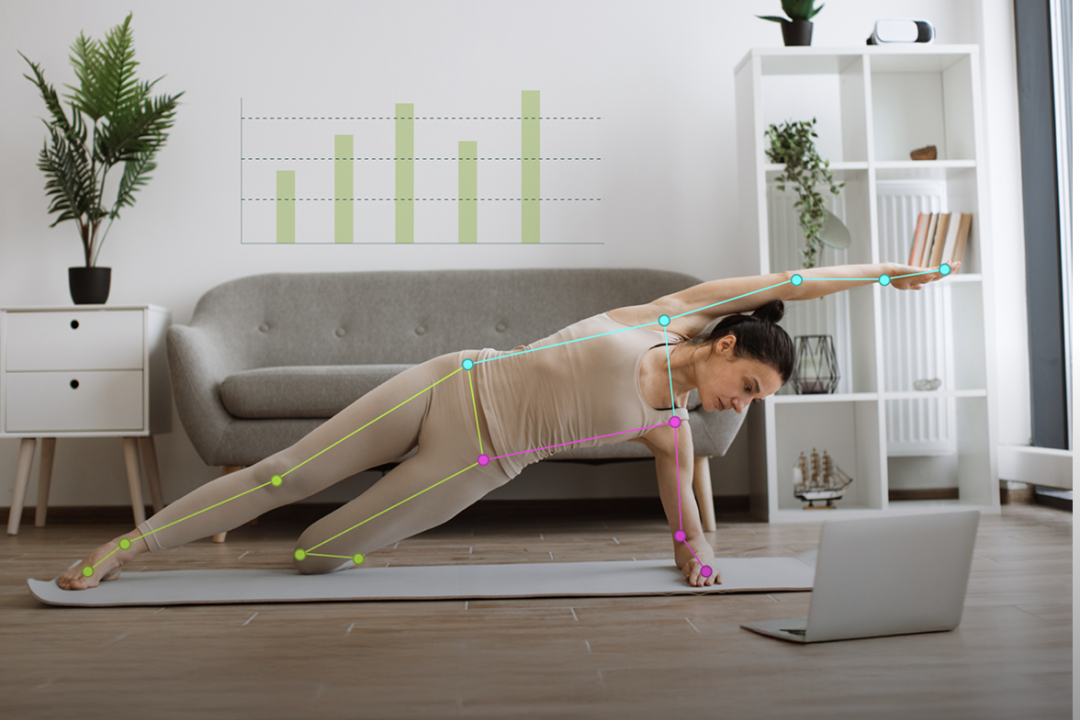
We built our Motion Capture feature to bring that same objective tracking into the home exercise program itself, using nothing more than the webcam a patient already has. When a patient starts a prescribed exercise inside PhysiApp, the feature tracks their joint angles in real time and follows the movement of specific body points without any wearable sensors or markers stuck to the skin. A patient can open the app on a laptop or phone and start exercising with no setup beyond pointing the camera at themselves.
During the session, the feature counts each rep automatically and times how long a patient holds a stretch or an isometric position. It compares the movement against the target range of motion you prescribed. When posture drifts from that target, the patient hears a voice-guided cue telling them how to correct it, so a squat that collapses inward or a shoulder that shrugs to compensate gets flagged in the moment rather than at the next visit.
The result is objective session data for the exact exercises you already prescribe, generated by the patient's own device in their own living room. Rep counts, hold durations, form warnings, and range of motion achieved against target all come from movement the software actually observed, not from a patient's memory of how the session went.
Motion Capture is currently in a coming soon stage inside PhysiApp, and clinicians can join the waitlist to be notified when it opens. We are describing it here because it makes a broad category shift concrete. The kind of objective movement measurement that Orlando Health and Gillette Children's run in dedicated lab space is starting to fit inside the daily home exercise program, and it does so without lab cameras, force plates, or a clinic visit. That changes what you can know about the days between appointments.
What changes for the clinician
The session data lands in the dashboard you already use, with no separate app to check and no new report to chase down. When a patient completes a prescribed exercise through PhysiApp, the reps counted, hold durations timed, form warnings triggered, and range of motion achieved against target all post to the same clinician view where you built the program. You open the patient record and see what actually happened between visits, not a self-reported number a patient half-remembers.
That objective record changes the questions you can answer before a patient walks back in. Instead of asking whether they did their exercises, you can see that they completed 8 of 12 prescribed reps on a lunge and that their form warning fired repeatedly on the last set. You arrive at the follow-up already knowing where the plan held and where it broke down, which lets you spend the visit adjusting rather than reconstructing.
Motion Capture measures and reports. It does not decide. It counts reps, times holds, and flags when a joint angle deviates from the target you set, and it stops there. It does not diagnose a condition, recommend a progression, or judge whether the deviation matters for this particular patient. You read the numbers against everything you know about that person, and you make the call to progress, hold, or change the exercise.
The result is a tighter feedback loop between what you prescribe and what you can verify. Your clinical judgment still runs the plan. The data gives that judgment something objective to work from.
What changes for the patient
A patient doing a prescribed squat sees a paper handout or a demo video, and neither tells them whether their knee is caving in or their depth is short. Motion Capture inside PhysiApp watches joint angles through the webcam during the exercise and speaks up the moment posture drifts from the target. If the patient's hip drops below the prescribed range or a hold ends early, they hear a spoken cue while they are still moving, not a red mark on a report the next morning.
That timing matters because form breaks down silently. A patient who thinks they are doing the exercise correctly keeps reinforcing the wrong pattern for weeks. Voice-guided correction during the session lets them adjust on the spot and finish the set with the movement their clinician actually intended.
The steadier result is confidence between visits. Many patients quietly disengage from a home program because they are unsure whether they are helping or harming themselves, and a static handout gives them no way to check. Real-time cues tell the patient when a rep counts and when it needs correcting, so they finish each session knowing the work was done properly. That reassurance keeps patients returning to the program on the days when no clinician is watching, which is most of them.
How privacy and data handling work
Physitrack's Motion Capture never records or transmits video. All joint-angle tracking runs on-device or in-browser during the session, and the camera feed stays on the patient's own machine. Only structured numeric data reaches your dashboard, meaning rep counts, hold durations, form warnings, and range of motion achieved against target. No image or video ever leaves the patient's device, so your patient can exercise in their living room without a camera stream traveling anywhere.
That data model matters for two reasons. It keeps the patient comfortable enough to actually use the feature, and it gives you clean, comparable numbers instead of footage you would have to watch back.
The scope of Motion Capture is deliberately narrow. It counts reps, measures joint angles, and flags when a patient's posture deviates from the prescribed target. It does not diagnose conditions, recommend treatment, or make any clinical decision. Every number arrives as evidence for you to interpret, and you make the call on progression, regression, or a change in plan. Motion Capture measures and reports. You practice medicine.
Keeping the tool inside these limits is what makes the objective data trustworthy. You know exactly what each figure represents, and you know it never replaces your judgment about what that figure means for a specific patient.
Where this fits in a clinic's technology stack
Home-based motion tracking complements a hospital gait lab, it does not replace one. A gait lab still captures the detailed, specialized analysis that guides decisions like ACL return-to-sport clearance. Physitrack's Motion Capture handles a different job, tracking the daily prescribed exercises a patient does at home between visits, where no lab equipment exists.
Physitrack remains a home exercise program platform first. The 18,000-plus exercise library and the smart search program builder define what clinicians prescribe. Motion Capture and remote therapeutic monitoring extend that prescription with objective session data, they do not redefine the platform.
If you direct a clinic and you're weighing this category now, evaluate it on a plain question. Do you want objective evidence of what patients actually completed between visits, delivered into a dashboard your clinicians already use. Physitrack's Motion Capture answers that question without adding a workflow, and it leaves every clinical decision with the clinician. You can join the waitlist inside PhysiApp while the feature moves toward release.